Report
Visier Trends 2026: Moving from Support to Strategic in the AI Era
Published:
What is people analytics? Learn how AI in people analytics helps HR teams make better decisions around hiring, retention, diversity, and performance.
· 13M Read
Most organizations don't have a data problem. They have dashboards. Reports. Survey results, performance reviews, and compensation data sitting in separate systems.
And yet, executives still struggle to answer basic questions: Are we structured correctly for growth? Where will performance risk show up next? Which workforce investments are actually working?
The issue isn't visibility.
It's the gap between insight and action — the inability to connect what the data is showing with what should happen next across hiring, reskilling, organizational design, and capital allocation.
That's the problem AI in people analytics is built to solve. Not just surfacing information, but connecting it into a shared, trusted foundation that guides workforce decisions — clearly and continuously.
That's what we'll cover in this guide.
People analytics is the practice of collecting and transforming HR and organizational data into insights that improve the way you run your business. You'll also see it called HR analytics or workforce analytics—they refer to the same discipline.
It's different from traditional HR reporting. Traditional reporting shows you outcomes.
People analytics—combined with workforce intelligence—connects multiple data points to bring context and meaning to those outcomes, so leaders understand not just what happened, but why, and what to do next.
At the enterprise scale, AI is what makes this possible. Without it, connecting signals across turnover, engagement, performance, and organizational structure would take a team of analysts weeks. With it, those connections happen continuously, surfacing the patterns that matter before they show up in financial results.
Visier partnered with Deloitte to survey 500 business leaders. We found that while most lacked confidence in their ability to address everyday people challenges, 70% said better access to people data would help them make faster, more confident decisions.
So which data is most important, you ask? There are three metrics that any people analytics conversation starts with:
High turnover is a visible problem. But the more important question is what's driving it — and turnover data alone won't tell you that.
AI in people analytics can show you exit patterns segmented by team, manager, tenure, compensation band, and seasonality. That's when patterns become actionable.
Example and expectations: Every March, a retail chain sees its sales team turnover skyrocket. Turns out, that was bonus time. To fight it, they cranked up mid-year incentives and churn fell by 20%.
Engagement data tells you how people feel about working at your organization. High engagement correlates with lower turnover and stronger productivity—and crucially, it tends to shift before those outcomes do, making it a leading indicator rather than a lagging one.
Common engagement signals include eNPS scores, pulse survey results, and meeting participation.
The value of AI in people analytics here is the ability to connect these signals across multiple sources and surface early warnings before they escalate.
Example and expectations: Using Visier Workforce AI, a major manufacturer discovered that while a COVID RTO mandate barely moved turnover intention, job satisfaction and eNPS dropped significantly (leading indicators of future attrition). That data convinced leadership to introduce floating holidays, financial wellbeing programs, and mental health support that employees had been requesting for years.
Performance ratings and project completion rates are starting points. But a team missing deadlines could be under-resourced, blocked by approval chains, or poorly matched to the work.
AI in people analytics helps you move past surface metrics to diagnose root causes—so interventions address the actual problem, not just its symptoms.
Example and expectations: A Paris-based luxury retailer combined sales and workforce data in Visier’s Workforce AI (opens in a new tab) to spot performance trends across stores. They used predictive analytics to get ahead of staffing gaps before they hit the floor, optimizing headcount based on actual store demand instead of historical assumptions.
The data to understand your workforce already exists. It lives in the tools your organization uses every day:
HRIS
Payroll systems
Performance management tools
Engagement platforms
ATS/recruiting tools
Learning and development systems
The problem is that these systems don't communicate with each other. Turnover data lives in one place, engagement data in another, performance data in a third. Without integration, you're not doing people analytics—you're doing disconnected reporting.
Data integration means connecting your existing systems to a single platform so data flows automatically, stays current, and can be analyzed together.
And more importantly, it means you’re not manually exporting CSVs or reconciling conflicting numbers across tools. Everything syncs into one normalized data model.
A few examples of what this means in practice (and yes, Visier Workforce AI helps with all of it!):
Turnover spiking this quarter? See which teams or roles are struggling are affected and surface the contributing factors.
Engagement dropping? Identify the earliest disengagement signals before they escalate to attrition.
Improving hiring quality? Connect sourcing, hiring, and retention data to understand which candidates become your best long-term employees.
When Kong connected its Workday data through Visier, their people analytics revealed something unexpected: applicants who applied directly through their system had an 85% retention rate (opens in a new tab). After integrating their ATS hiring and HRIS retention data, they’re now focusing efforts on targeting, engaging, and fast-tracking these direct applicants to boost hiring efficiency.
Even with all your data connected, knowing what questions to ask—and finding the answers—used to require dedicated analysts. Visier Workforce AI changes that.
Rather than generating answers from disconnected data, Visier Workforce AI continuously interprets workforce signals such as roles, skills, organizational structures, movement patterns, and business context, all within a shared semantic framework.
This means everyone across HR, IT, and the business is working from the same trusted foundation and receiving consistent answers, not different interpretations of the same data.
Visier’s agent, Vee, is embedded in Visier Workforce AI to allow approved users to query the full workforce dataset in plain language. Ask it which departments have the highest flight risk right now, and it surfaces an answer grounded in verified organizational data.
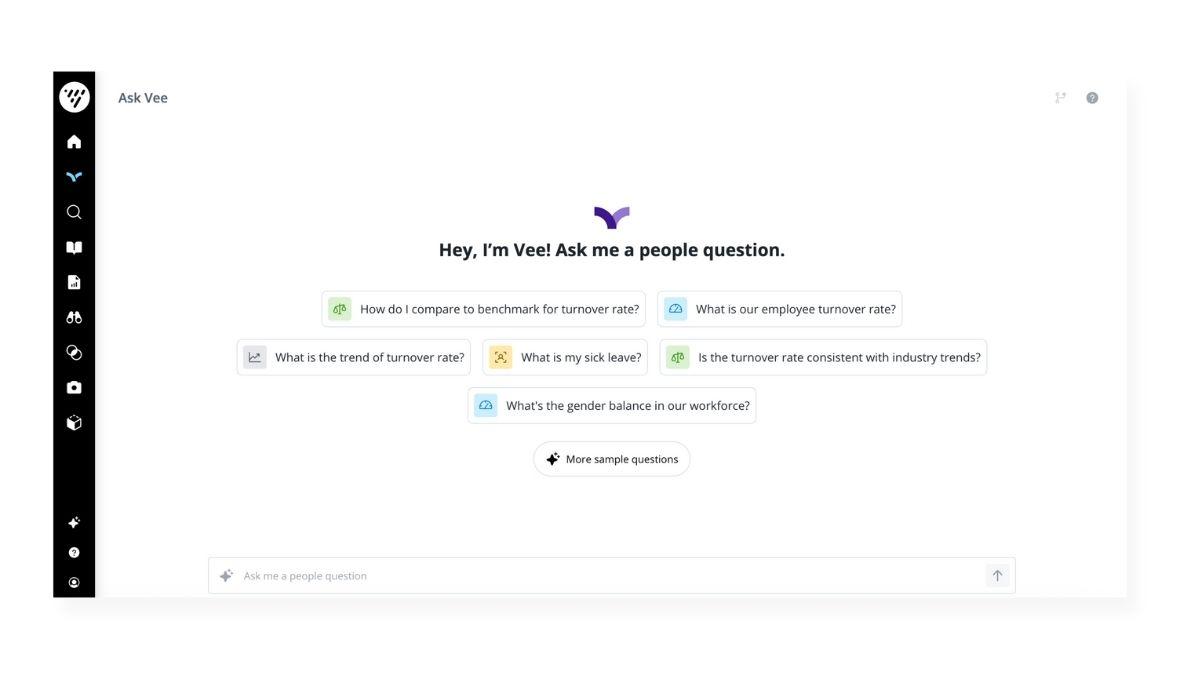
All this within moments.
There are two parts to the “people analytics” equation: gleaning insights and implementing results. Most companies handle huge volumes of workforce data, but they make the most of it by turning those numbers into actionable strategies. AI in people analytics closes that gap across four key areas.
Knowing where your best hires come from is a starting point. But people analytics can tell you:
Which sourcing channels produce your highest-tenure employees, not just your highest volume
Which roles are most likely to open up at a specific time based on historical attrition and growth patterns
Where your time-to-hire is too high and which stages in the process are causing it
Which candidate profiles correlate with long-term performance, reducing bias and guesswork in screening
Example: Providence, a Washington-based health services company, put that last insight to work in a tight labor market.
They used people analytics within Visier Workforce AI for accurate vacancy forecasting and a complete view of their workforce. They proactively hired more than 2,000 caregivers before shortages hit (and saved $3 million in the process (opens in a new tab)).
Use retention analytics to understand the conditions that lead people to leave your company. Then segment that data by team, department, tenure, manager, or location to find out who’s specifically affected and how your leadership can intervene before it becomes a vacancy.
Example: For Enbridge (opens in a new tab), Visier Workforce AI transformed the way they used machine learning, going from manual refreshes once a year to real-time analyses with self-service access to refreshed data whenever needed.
This gave the Enbridge team a complete picture of why employees left the organization, improving decision-making and helping them reach their diversity goals.
Companies in the top 25% for exec team gender diversity are 21% likelier to see above-average profitability. But it’s one of the hardest enterprise workforce problems to solve with data. It's collective work that can't be owned by one team, and gathering demographic information is super complicated across different countries and legal jurisdictions.
What people analytics changes in DEI is the feedback loop.
Instead of an annual diversity report that's already outdated by the time it lands, you get a continuous view of where representation is shifting.
Are gaps showing up in hiring, promotion, or retention?
Is progress happening in some teams but not others?
Those are very different problems with very different fixes.
Example: Snap built exactly that kind of visibility in what they call the “thoughtfulness approach.” They tracked hiring, attrition, and promotion data quarterly so their people team could see which levers were actually moving the needle on equity, then adjust in real time instead of waiting a full year to course correct.
Results: 2x Black women hires and 2x women in tech leadership roles.
Annual performance reviews are backward-looking by design. People analytics gives you a continuous view of performance trends that a single review cycle can't provide.
Visier Workforce AI pulls together performance ratings, project completion, feedback trends, and development activity over time so you can see:
Who's consistently delivering
Who's plateauing or disengaging
Who's being overlooked because they don't have the loudest manager in the room
That changes the conversation around who's ready for more responsibility, and where you have gaps in your succession pipeline.
Getting started with people analytics doesn't require a massive team or a full data infrastructure overhaul. Here's a practical path.
At minimum you need four functions covered—they don't necessarily have to be separate people, but the work has to get done.
A team lead who keeps projects tied to business priorities
Analysts who investigate trends and translate numbers into recommendations
Data engineers who handle integrations, pipelines, and data quality
HR business partners who connect insights to workforce decisions and solidify buy-in across the org
HR owns the questions, IT owns the infrastructure. If they're not aligned on that early, you'll waste time fighting over data access and system integrations, so decide on your core HR-IT collaboration model sooner rather than later.
Then, identify data champions in each business unit who can bridge the gap, and invest in upskilling so that insights don't bottleneck at the analytics team.Even a small team can punch well above its weight when the platform handles the heavy lifting. Automated pipelines, connected data sources, and AI-driven recommendations mean you're spending most of your time on high-level decision-making.
Most organizations fall into one of three stages:
Reactive reporting: You're pulling data after something goes wrong. Turnover spiked, leadership wants answers, you're looking through spreadsheets and individual tools to find answers.
Proactive analytics: You have connected data sources, a regular cadence of insights, and HR leaders who are using data to inform decisions before problems escalate.
Predictive AI: You're anticipating turnover, flagging flight risks, modeling workforce scenarios, and actively influencing business strategy. This is what “good” looks like at scale.And it's also where people analytics expands into something broader: workforce intelligence. The difference is scope. People analytics tells you what's happening with your workforce. Workforce intelligence connects that understanding to planning and action across the organization, so HR, Finance, and business leaders are all operating from the same trusted foundation when decisions get made.
Since you’re reading this, you’re probably somewhere between stage one and two.
Start by using Visier to connect your core systems and establish a regular reporting cadence. Once you have that, the next move is building predictive models for your highest-cost workforce problems. (Attrition and hiring are normally the best place to start.)
At full maturity, people analytics grows from an HR function into a business strategy input. Workforce data influences headcount planning, org design, M&A decisions, and productivity investment.
This is where Visier's Workforce AI's predictive capabilities (and Vee's ability to put that analysis in anyone's hands) become a genuine competitive advantage.
By the time you hit this point, tech isn't your bottleneck anymore; trust is.
Old school leaders who didn't grow up making AI-driven decisions will second-guess models they don't understand. Execs will want to see the methodology before they act on a recommendation. Managers might even dismiss, e.g., attrition predictions because they “know their team.”
That's a normal part of scaling a people analytics function.
The teams that get past it do two things. First, they use storytelling to present HR data; and second, they rack up small wins that build credibility over time – for instance, how an analytics-informed retention intervention saved money.
The gap between the workforce decisions you're making today and the ones you could be making with the right insights is probably a lot bigger than you realize.
The organizations pulling ahead aren't doing it by hiring more analysts or running more surveys. They're doing it by connecting their workforce data into a trusted, coherent foundation they can reason from and act on, continuously.
The shift is already underway: from knowing what happened to guiding what should happen next. The leaders who move from insight to action first will adapt faster, allocate capital smarter, and build workforces designed for resilience.
The question isn't whether your organization needs AI in people analytics. It's how much runway you want before the organizations that have it start making better decisions than you are.
Learn more about the new era of people analytics and workforce intelligence and see how Visier Workforce AI can take your insights to the next level.
People analytics is the collection and transformation of HR data and organizational data into actionable insights that improve critical talent and business outcomes.
HR metrics such as turnover rates, engagement scores, and productivity measurement provide insight into employee retention, satisfaction, and who's delivering tangible results. The people analytics metrics should be in line with your workforce development and strategic business goals.
Organizations can use people analytics tools like Visier to pull from common challenges they have (such as retaining high talent/talent retention and slow hiring/long time to fill a position) and identify key employee data aspects. They can then work with the initial insights to find quick wins and relay them to their leadership.
Mature people analytics teams face complex challenges, such as messy or incompatible data, privacy and security issues, and equitable buy-in from the organization's management. As teams grow, building out robust approaches to data governance and encouraging an analytics-friendly culture become vital steps in overcoming these challenges.
People analytics meets HR every step of the way for turning data from the workforce into strategy around hiring, retention, learning, and diversity. With analytics woven into traditional HR processes, you can go beyond mere data administration to developing data points that inform decisions around how you develop programs, anticipate issues, and drive success.