eBook
The Fundamental Role of People Analytics in Organization Design
Published:
Organization design only works when C-suite, HRBPs, Org Design specialists, Workforce Planning, and People Analytics each know their role and work from the same data. This piece breaks down what each player brings and how coordination leads to workforce impacts.
· 6M Read
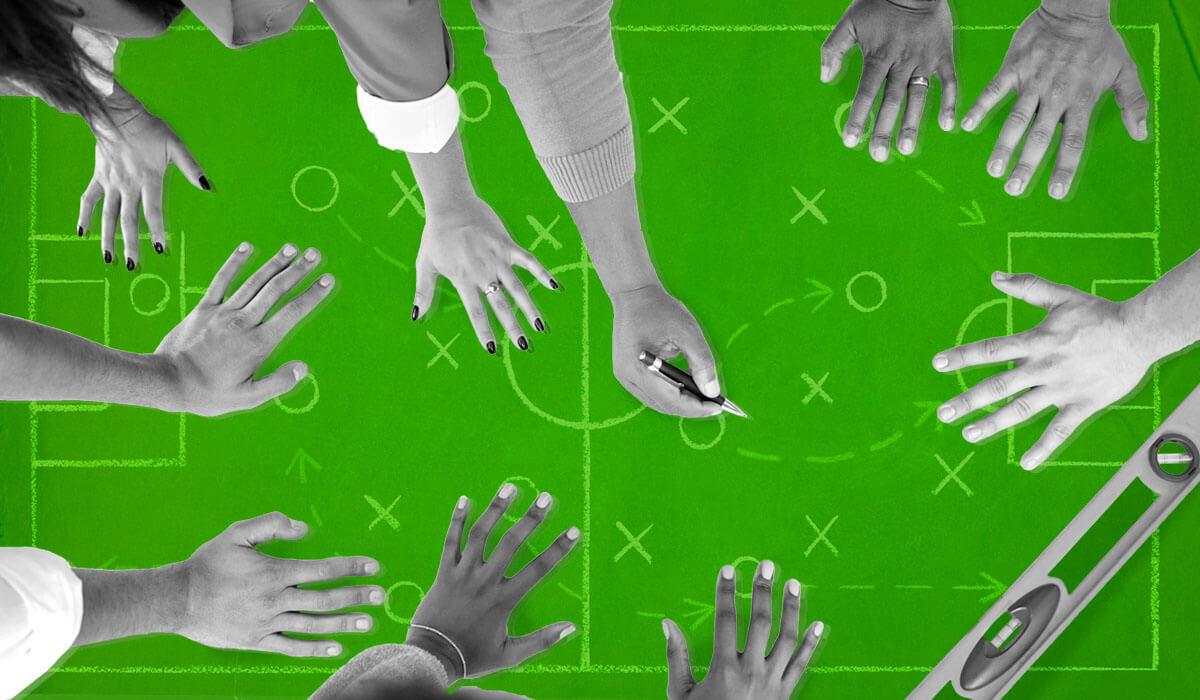
Everyone thinks they own organization design, but no one person or team fully does. Organization design, as a process, works only when it involves and connects all the relevant players.
Like any great team sport, organization design works best when everyone on the team knows their role, works from the same playbook, and has the right information at the right moment. Get that right, and the whole organization moves better. Get it wrong, and the gaps show up where you least expect them.
In this piece, we break down the five key players in any organizational design effort—who they are, what they bring to the field, and why no single all-star can win the game alone.
Organization design is a team sport, with its best plays happening when there are multiple people from across the organization working toward the same design principles.
The risk of relying on a single all-star player, (say an organizational design specialist) to carry the entire design process over the goal line is a critical point of failure. In organization design you need people who study the game, people who study the competition, people who know the strengths on the field, and people who make the call when it counts.
In organization design, these roles map directly to the people in your organization.
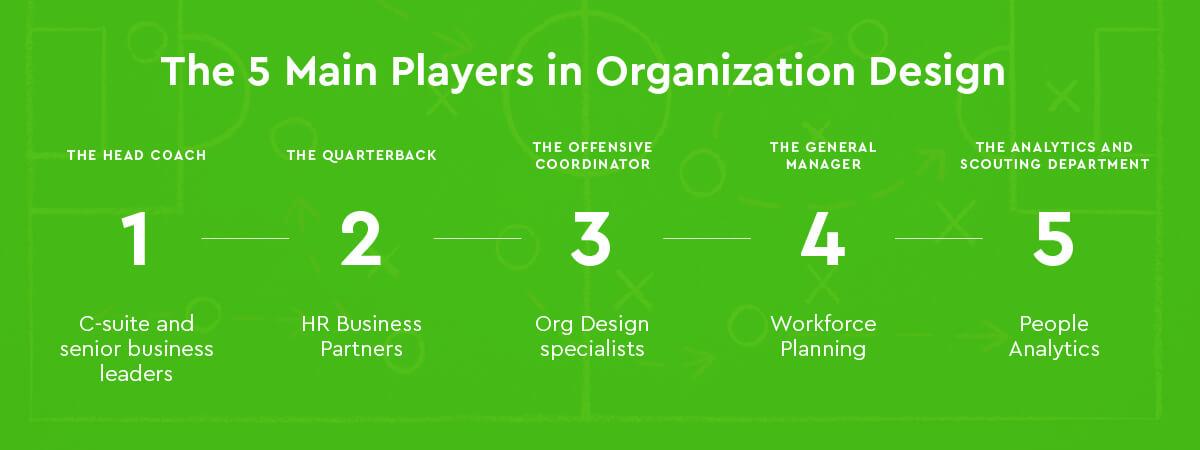
C-suite sets the agenda for the company’s organization design, helping establish the company’s north star. They create the design principles addressing the following questions:
What does it mean for something to work at this specific organization?
Who do we want to be?
What are our negotiables?
How does culture play a part in the design?
But, too often, I see senior business leaders being asked to get into the weeds, which is where the pieces are far too granular or tactical for their high-level knowledge.
C-suite leaders shouldn’t be making individual-level decisions. Like a great coaching team, they want to see how it comes together but they should never be thinking about a single player or a single employee.
For this reason, senior business leaders should focus on aggregate data. Instead of focusing on the minutiae of who ends up moving where, they focus on the impact to business results.
HRBPs are closest to the action, and in larger ones, they're translating organizational level strategy into reality while juggling a dozen other priorities. Like a quarterback reading the field in real time, they're constantly making judgment calls under pressure.
When organization design gets too complex or too frequent, HRBPs run the highest risk of burnout. Especially considering they are also the firefighters in many other areas of the business, making constant triage decisions with their time.
Organization design decisions help surface the gaps that inform the programs HRBPs want to build, so their involvement is mission critical. But, they need the right tools to facilitate their judgment calls, in order to speed up their assessment of the behavioral and teaming issues.
Not every organization has one, but when they do, Org Design specialists are the ones who've studied the playbook inside and out. I see them as an offensive coordinator, because they design the system to best anticipate how the pieces fit together before anyone takes the field.
I tend to find Org Design specialists in mature organizations, high-growth companies or those with heavy M&A activity. These are the teams that need to handle constant shuffling.
But that's changing. As better tools reach teams of all sizes, the Org Design playbook is getting democratized and organization design is becoming something every team can learn to run.
The GM doesn't coach the game, but they definitely care about the final score, because they are responsible for building the roster. For example, Workforce Planning tells you how many people you need and who they are, while Organization Design tells you how to deploy them.
Yet, too often these run as separate tracks, with Workforce Planning aligned closely with finance and Org Design aligned with HR. But, in most cases, by the time a structure gets finalized, it might already reflect a workforce that's moved on.
Knowing how many people you need is only half the battle; getting the best out of your people is the other half. So, it shouldn’t be a surprise that when you can bring together all the pieces that typically span both organizational views, you get better results. And increasingly, in this world of strategic workforce planning, practitioners who hold both skillsets are emerging.
Every great professional football team has a scouting and analytics department working in the background. They are studying videos, modeling scenarios, and flagging risks before they show up on the scoreboard.
People Analytics gives Organization Design the information they need, significantly cutting down discovery time. It’s about cutting costs, reducing risks, and supplying the right data to drive smarter human decisions.
But people analytics feels like something we still take for granted, even though it’s existed 15 years as an established role.
Mature people analytics functions track predictive metrics tied to who might retire or who might leave. Imagine designing a new organization without double checking people analytics—you might miss a critical person, a newly appointed leader, etc. But by cross referencing with People Analytics, you can be prepared for what could be a morale crisis if not handled well.
Visier gives you a trusted, AI-enabled organization design solution to help you better evaluate, and monitor design decisions. Model multiple scenarios as you refine, coordinate between all players, and stay on track with proactive AI-powered monitoring.
Let me paint a picture:
The HRBP is making triage decisions across 10 other priorities. The Org Design specialist, if there is one, is putting out the biggest fire. Workforce Planning is running numbers against an organizational structure that's already changed. And the C-suite is designing around aggregate data that people analytics hasn't had a chance to validate. Yet, decisions are getting made anyway, with unforeseen workforce impacts surfacing 60 to 90 days later, long after these changes were kicked into motion.
Obviously, no individual or team is doing something wrong, but there are clearly issues with the handoffs. But this is where people analytics makes this team sport possible, and helps it win.
When people analytics is connected to the process from the start, rather than pulled in to validate decisions that are already half-made, the handoffs between each team player work much more effectively:
The C-suite gets aggregate data they can trust. The Org Design specialist gets scenario modeling backed by real workforce intelligence, not stale exports. Workforce Planning and Org Design stop running parallel tracks and start working from the same foundational model. And the HRBP finally gets a clear set of facts to focus on, so they can read the behavioral and teaming issues that no data set can surface on its own.
It's time we all took our place as the owners of organization design. Every group has an important role to play. From strategy to analytics, each will weigh in.
To see how people analytics fits into the full organization design picture, dive into The Fundamental Role of People Analytics in Organization Design.
![[featured resource] strategic-workforce-planning-ai-era](/_next/image/?url=https%3A%2F%2Fimages.ctfassets.net%2F3geimt851116%2F1Z3UoMR1C6vfcYRCZUJYbX%2F71a9de51a9902d704ff6d6be0c5e4af9%2FStrategicWorkforcePlanning-DownloadImage-576x411.jpg&w=3840&q=75)