
Webinar
How to Move Workforce Planning From Reporting to Decision Intelligence
Published:
Our most recent research revealed that 77% of companies redesigned their team structures in the past five years, causing ripple effects on the ways people collaborate, communicate, and make decisions.
· 4M Read

Since the explosion of generative AI back in 2022, leaders have faced immense pressure to leverage the technology for cost savings and productivity.
The power of AI promises unprecedented efficiency gains; for employees, the prospect of being replaced by generative AI leads to great uncertainty and fears of job losses. Gartner estimated that AI investments could as likely shift talent needs than eliminate them, potentially driving a 30% increase (opens in a new tab) in headcount in some business units by 2028.
The reality, most likely, will lie somewhere in the middle.
For those entrusted with designing the workforce of the future, what matters now is that Organization Design has become a strategic necessity.
One of the aspects organization design tackles is the team unit. Teams are the fundamental architectural building blocks in an organization.
By manipulating team size and the total number of teams, leaders can deliberately reshape the organization's DNA to achieve specific strategic outcomes.
But what is less known is exactly how organizations typically accomplish the optimization of team structures in times of change, raising the following questions:
How do organizations redesign team structures when adding or reducing headcount?
Do the majority of companies indeed flatten team structures, and widen the remaining managers' span of control?
And how do various redesign scenarios impact teams and managers?
That’s exactly what we set out to uncover and understand in our latest Visier Insights™ Report, “The New DNA of Organization Design.”
We analyzed 7.7 million live employee records across over 170 enterprise organizations in the Visier Community Data pool to learn how organizational headcount growth and reductions played out at the team level.
We identified six of the most common scenarios (see figure), three of which are linked to headcount growth (green) and three that are linked to headcount reductions (red).
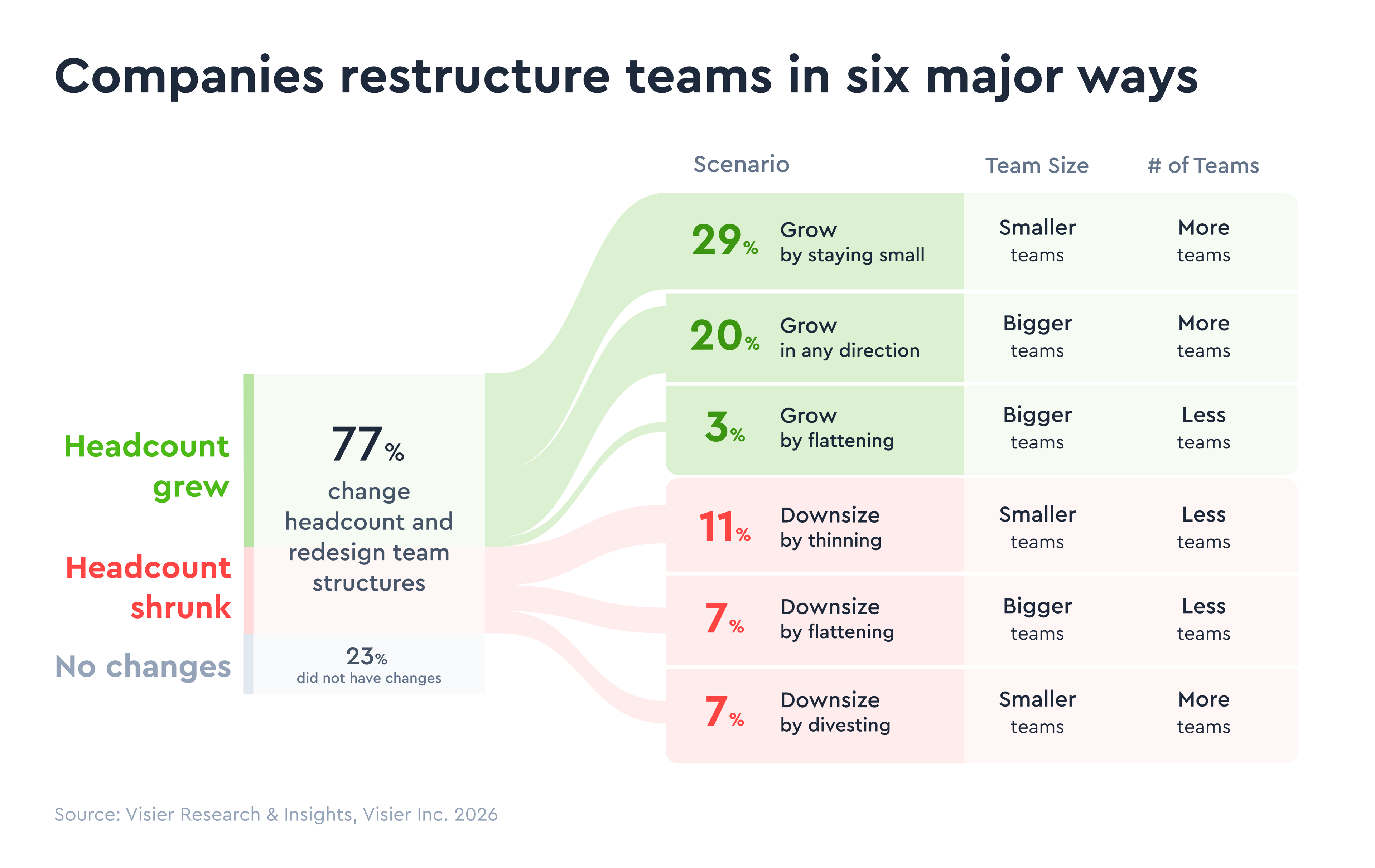
Turns out that over the past five years (our data analysis ended in November of 2025) the majority of companies actually had smaller teams, both when losing employees due to headcount reductions, but also when adding employees or increasing headcount.
For example, when looking across all companies, the largest proportion, 29%, did so “by staying small.” Meaning, those who added employees showed a larger number of teams (by 20% on average), but smaller teams by approximately 7%.
This suggests that more often than not, growing companies pursue narrower spans of control for managers, hoping to achieve faster decision making, direct communication, and autonomy.
Similarly, of those companies that reduced headcount, the majority, 11% of them, downsized by “thinning” but also showed up with 20% fewer teams, and smaller teams by about 11%.
This suggests that when organizations reduce headcount—whether across the business or within a specific unit—the primary path to greater efficiency, agility, and speed is maintaining faster decision-making and direct communication.
The risks associated with the creation of smaller teams plays out differently in growing or shrinking organizations
Smaller teams in growing units could fall into the trap of losing alignment with the wider organization and group think (opens in a new tab),
Shrinking teams in a downsizing scenario could battle with the loss of loss of human capital (opens in a new tab), as well as decreased commitment and performance (opens in a new tab).
But what really surprised us was in relation to the “Great Flattening (opens in a new tab) Trend.” This is the trend of eliminating middle managers through team consolidation, which results in larger teams and wider spans of control for remaining managers.
We discovered in our analysis that this trend Great Flattening only occurred in about 10% of all companies, rendering the term “great” flattening really a myth (see figure).
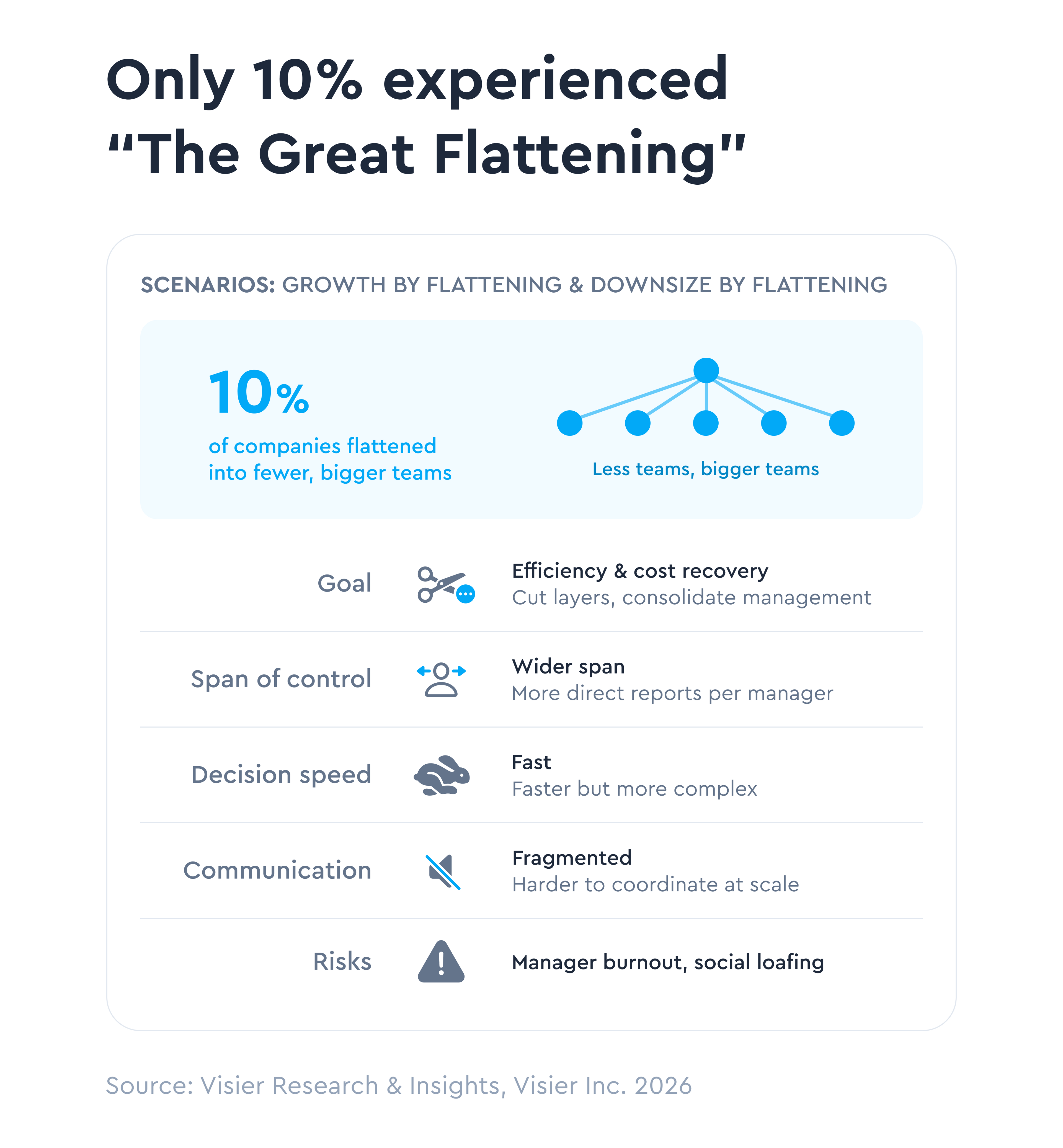
The trend of consolidating into fewer, larger teams is primarily pursued in the spirit of cost savings (lower payroll and reduced bureaucracy), rather than being a sign of growth and prosperity.
Fewer managers and larger teams enable faster decision-making and greater team autonomy due to the elimination of top-down communication barriers, in theory.
However, research has found that this type of team structure often fails in large hierarchical organizations because it frequently leads to coordination failures (opens in a new tab).
This analysis offers a data-driven blueprint of real world reorganization scenarios. Most importantly it serves to outline the distinct benefits and inherent risks of various team design scenarios that leaders may encounter, especially in the face of what could be a long-term AI-triggered workforce transformation.
Companies and their internal units will continue to change as the business landscape shifts; they will keep adding and losing employees, split up, or transform their operations altogether.
This is why organization design cannot be thought of as a static exercise.
Business and HR leaders face the constant challenge of redesigning their organizations, and this has become an impossible task without data.
From a business and human capital perspective, it is more critical than ever to have the necessary data and metrics that provide a live view of the organizational impact and consequences from constantly evolving organization design scenarios.
Learn more about our research, including a curated list of metrics to track for effective organization design: