Guide
Smarter Workforce Intelligence: How To Scale Your People Decisions
Published:
AI is reshaping the world of work faster than traditional workforce planning cycles can absorb. Here, Paul Rubenstein, Visier’s Chief Evangelist, outlines a new HR operating model centered on: Design, Plan, and Operate. He makes the case for workforce intelligence to turn discrete HR processes into a coherent, real-time people strategy.
· 7M Read

Strategic workforce planning was built for a slower world. For decades, HR teams invested months modeling assumptions, aligning stakeholders, and producing the plan that would guide headcount, hiring, real estate, and learning for the next one to three years. It was rigorous. It was deliberate, and it worked—until it didn't.
The economics of work are shifting too fast for annual cycles to keep up. Leading organizations are now revisiting their workforce plans twice a quarter or more but of necessity. AI is compressing decision timelines, while competitive pressure demands faster pivots on cost and innovation. Layer in the current state of macroeconomic volatility, and it means January's assumptions can be obsolete by March.
The old once-a-year planning rhythm is no longer functional.
What's required today is a fundamentally different approach to people analytics and workforce intelligence.
I propose an operating model built on three interconnected capabilities: Design, Plan, and Operate. Together, they give HR the infrastructure to move at the speed of business and as a genuine partner to the business.
This post was originally published on Paul Rubenstein's Substack, HR is Dead. Long Live HR (opens in a new tab).
I’ve found that many organizations begin their AI journey in the wrong place. They invest in tools, roll out platforms, and measure adoption. What organizations rarely do is ask the harder question: has the work itself actually changed?
That's where Design comes in. In my opinion, this is where the gap between AI investment and AI value tends to live.
Why? Because adding yet another piece in the tech stack doesn't move the needle. What moves the needle is work that has been deliberately restructured around what AI can do. For HR, this represents a genuinely new mandate and the foundation of strategic workforce planning in an AI-driven era.
This work starts with an honest, task-level look at every role. Not job titles or functions—tasks. Because within any given job, some work is irreducibly human: it requires judgment, relational intelligence, creativity, and the ability to navigate ambiguity. That work should stay with people, and ideally expand.
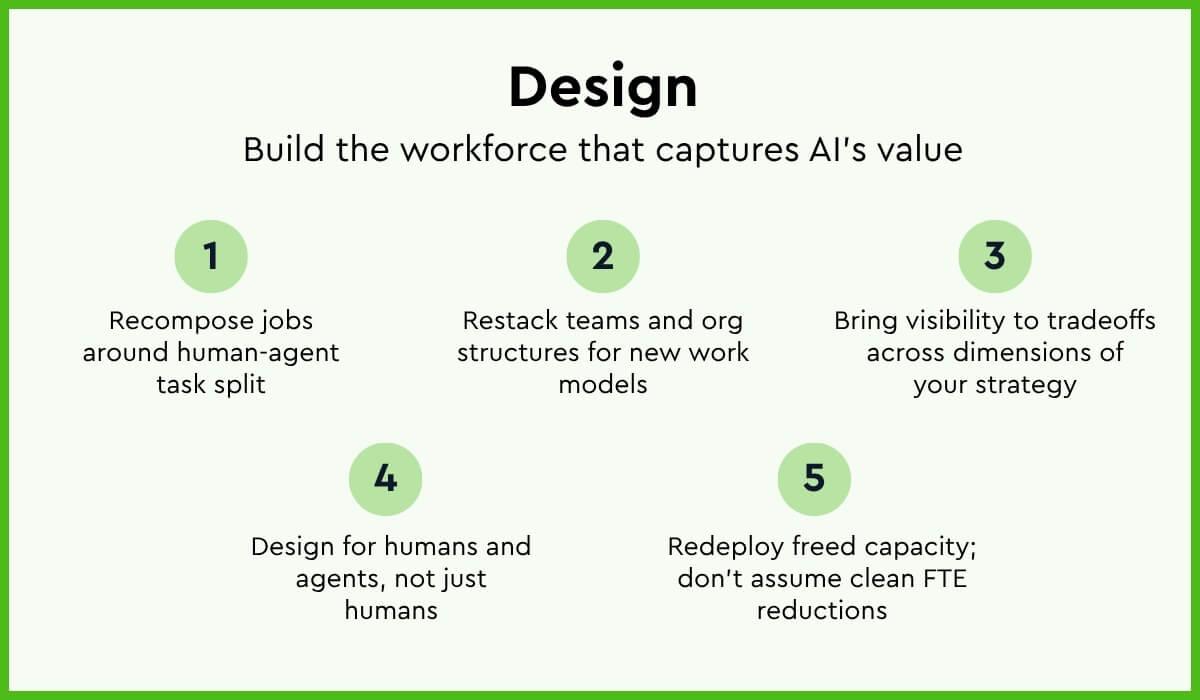
Other work is structured, predictable, and rule-bound. That work is ripe for automation or agent assistance. Once you've mapped that distinction, the Design decisions should follow naturally leading to three types of choices:
Job recomposition: reconstructing roles so people spend their time on higher-value work, with agents handling the rest.
Job restacking: reorganizing teams and reporting relationships to reflect the new human-agent mix.
New organizational structures: Developing org structures that didn't exist before AI and which have been purpose-built to execute work in fundamentally different ways.
The Design challenge isn't purely organizational, either. There's a financial dimension that trips up nearly every leadership team I work with.
When AI augments a worker's productivity by 20 to 30 percent, the efficiency gain is real but it's distributed in fractions across many people. You can't lay off one-tenth of a person. You can't convert fractional capacity gains directly into headcount reductions without creating operational gaps and workforce instability.
Capturing that value requires active redeployment: intentional movement of freed capacity toward higher-value work.
Done well, Design also makes work more human. When agents absorb the administrative burden, like compliance checking, data retrieval, routine coordination, what remains is the work that draws on what makes human contribution distinctive.
Ask most HR leaders whether they do strategic workforce planning, and the answer is yes. Ask them to show you the plan, and what you'll usually find is a headcount model: roles, locations, and costs. Technically, this is just a budget.
A real Plan starts with a different question: not "what do we have?" but "what does the business actually need to execute its strategy?" The answer has to span every dimension that drives workforce performance:
Skills
Spans of control
Organizational layers
Team composition
Human-to-agent ratios
Location
Pace of workforce
If we take a critical look at these dimensions, they are no longer just describing what you have. Instead, they describe what you need, and then go a step further, to quantify the gap between the two. This is the crucial link between Design and Operate.
Design defines the target architecture and the Plan makes it actionable. Not just "hire an FTE," but hire this role, with these skills, in this location, with this span of responsibility, at this pace.
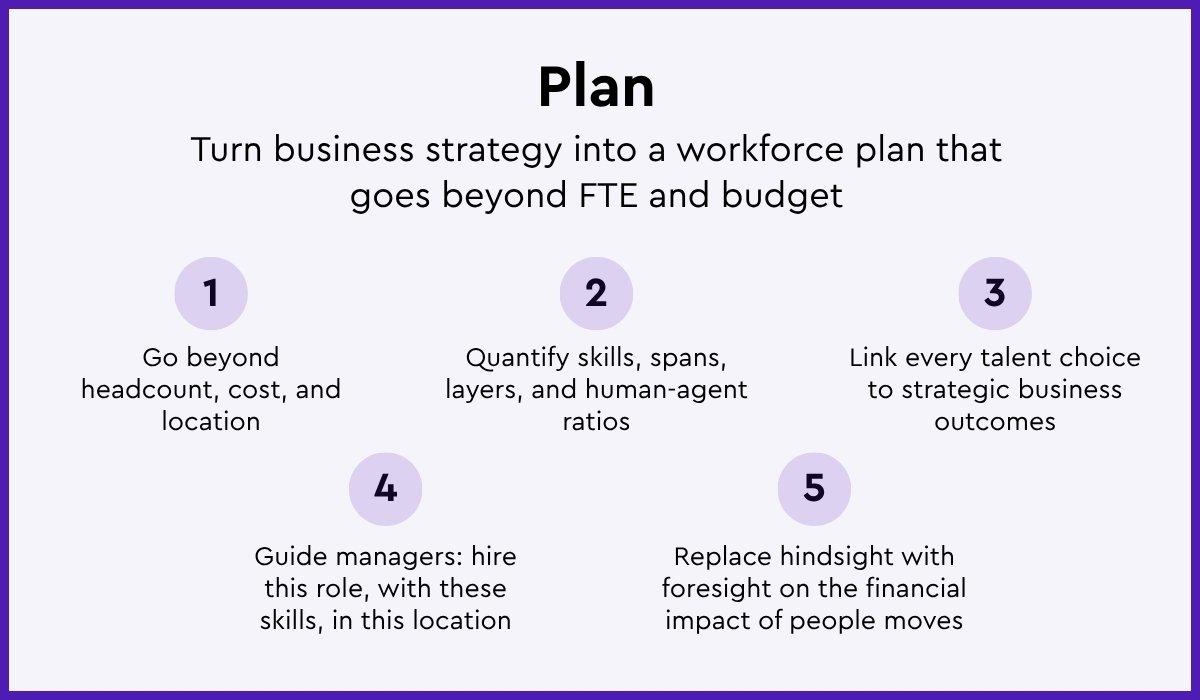
This framework specificity changes how talent decisions get made. Without it, managers default to the path of least resistance: replacing what they had, with what's available, at roughly the same cost. The workforce stands still or worse, drifts backward, rather than building for the future.
With the Plan, every hire, promotion, and reorganization is evaluated against a forward-looking target rather than a historical reference point. Because the target is shared and visible, it also creates the conditions for real accountability. Leaders can be held responsible for workforce outcomes they can actually see and track.
Getting to this level of specificity requires more than better spreadsheets. It requires Workforce Intelligence: a live, synthesized view across skills, attrition risk, market availability, performance, and organizational design, one that updates as conditions change rather than just when the annual planning cycle rolls around.
HR has always owned the operational core of the workforce: hiring, developing, retaining, paying, and eventually off boarding. And over the years, the profession has built genuinely sophisticated capabilities across each of those areas.
Each process works, but together, they rarely add up to a management system. Of course, finance cracked this problem decades ago. The CFO's function still processes transactions, of course, but that is table stakes. What finance actually runs is a management discipline: a planning baseline, a monitoring cadence, a variance detection mechanism, and a course-correction loop.
Every business leader operates within that rhythm. Every CFO can tell you the gap between actual performance and plan, and every business leader knows they will be asked to explain it.
https://visier.wistia.com/s/n4yic8vewwwcd0r (opens in a new tab)
HR needs to adapt that same architecture to the workforce.
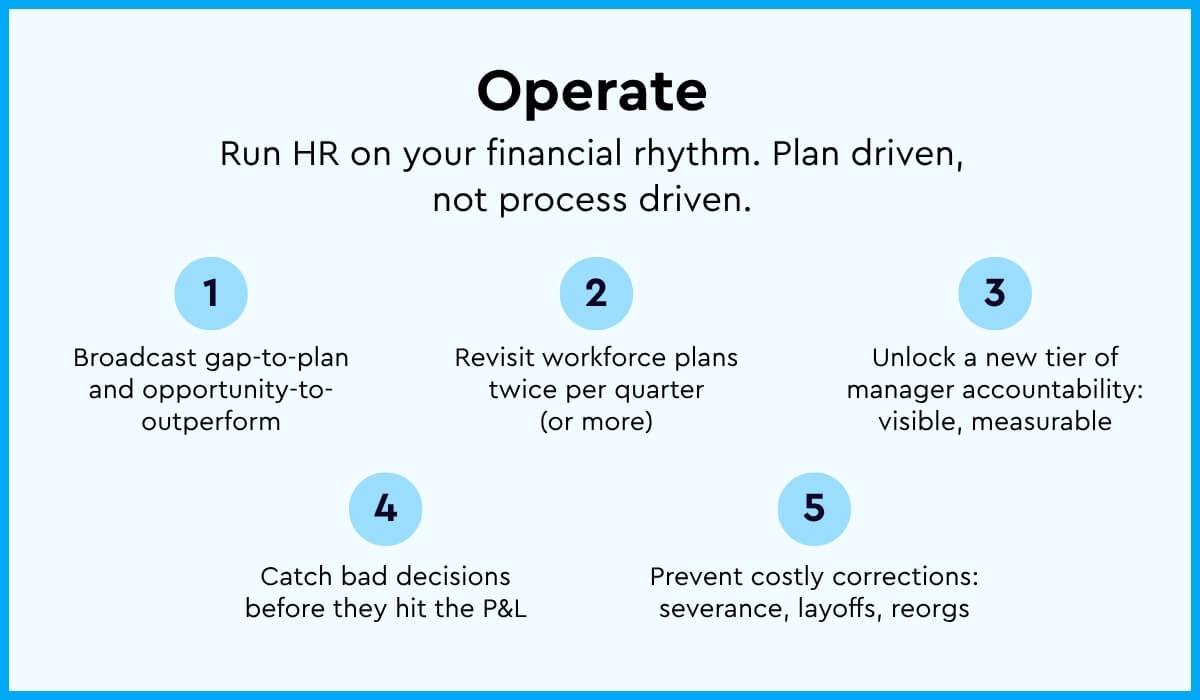
With the workforce Plan serving as the baseline, two questions replace the traditional metrics as the organizing logic behind HR's operating rhythm:
Where are we behind in the Plan?
Where do we have the opportunity to outperform?
Every review and every conversation about talent, gets oriented around these questions to transform manager accountability. A manager hiring the wrong profile, under-investing in a critical team, or ignoring a capability gap is making a decision that can be measured against the Plan, and that visibility can finally help change behavior.
So this is where Operate, when done well, pays for itself. Severance, layoffs, and reorganizations are often treated as the cost of doing business. Connecting insights to impact means seeing the warning signs early enough to act. That's what it looks like when HR stops being reactive and starts operating as a genuine partner to the business.
The Design-Plan-Operate model is only as powerful as the infrastructure running underneath it, and this infrastructure has two requirements: speed and a shared intelligence layer.
Speed is the more uncomfortable requirement. HR has to evolve beyond the traditional slow cadence of annual plans and quarterly reviews. Today the world is moving at light speed, with AI moving faster. HR's rhythm has to keep up, or risk putting the organization behind the progress of competitors.
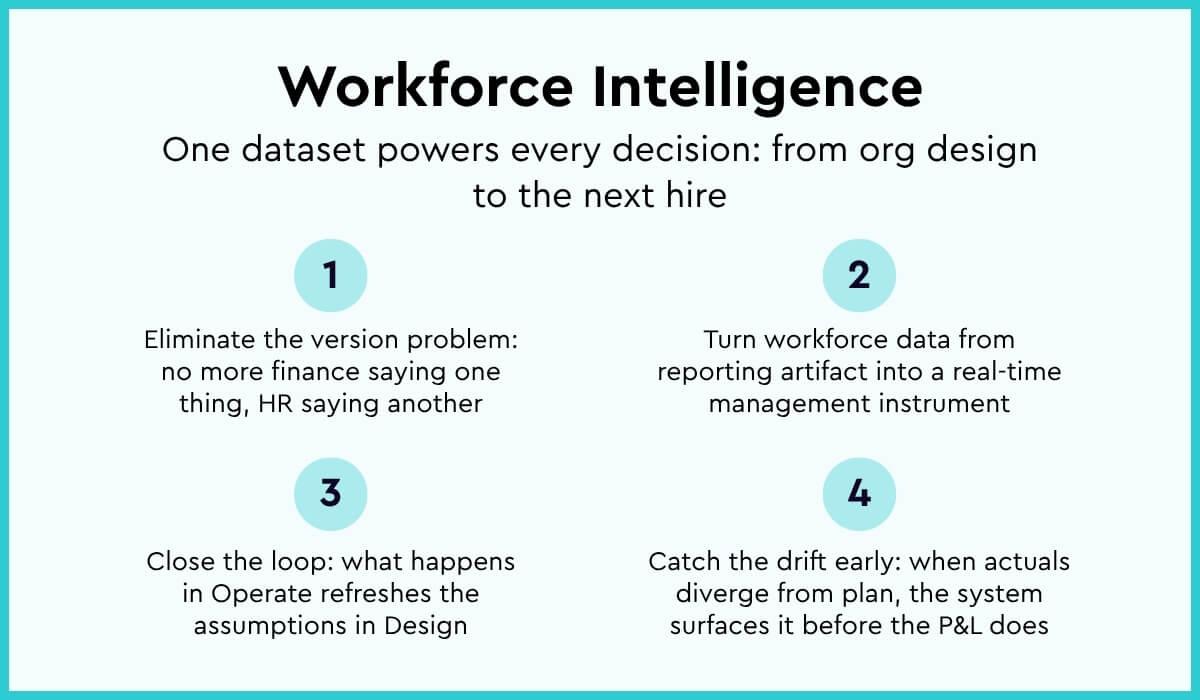
The second requirement is connection. Workforce Intelligence serves as the shared layer that keeps Design, Plan, and Operate working as a system rather than in silos. Every team—the organizational designer, the workforce planner, the HR business partner—works from the same analytical foundation and sees the same complete picture.
When both elements exist, HR stops being the function that responds after the fact. It becomes the function that sees what is coming and helps the business get ahead of it.
See how leading HR teams are moving to real-time decision intelligence from a single source of truth in How to Move Workforce Planning from Reporting to Decisions Intelligence, a discussion featuring insights from PepsiCo, RTX, and other global HR leaders.