
Blog
Why You Absolutely Shouldn’t Use an LLM for Workforce Data
Published:
Vee gives everyone fast, accurate answers about your workforce, grounded in your organization's own people data and context. Learn what Vee does and what's new.
· 8 min read

Vee, Visier's AI agent, instantly answers workforce questions for HRBPs, line managers, and CHROs, securely and accurately, so people insights reach every level of the organization.
Built specifically for HR and People Analytics, Vee reasons from 2,000+ pre-built workforce metrics and your organization's own people data, powered by the Visier Workforce Context Engine.
Vee works where people already work: in Visier People®, Microsoft Teams, Microsoft Copilot, and Slack. It can also connect to the AI agents your organization is building through MCP.
Vee is designed for enterprise-level scale and security. It's also the foundation for Vee for Partners, which speeds up generative AI product roadmaps for people tech SaaS vendors and solution providers
Vee is Visier's AI agent for workforce insights. Anyone can ask a workforce question in plain language and get an answer grounded in their organization's own people data and context.
Every answer is governed by role-based security.
Vee explains the "why" and "so what" behind each answer and suggests follow-up questions, so HR leaders, HRBPs, People Analytics teams, and managers can act on what they learn.
Vee works in Visier, Microsoft Teams, Microsoft Copilot, and Slack, and can also connect to other AI agents through MCP.
The Visier Workforce Context Engine, with 2,000+ pre-built metrics, gives Vee the definitions, timing, and permissions that general-purpose AI tools lack.
Three common obstacles stand in the way of a breakthrough people analytics function:
Gaining broad end-user adoption
Getting answers to questions quickly
Interpreting data correctly
Generative AI solves for the first two. Anyone can ask a question and get an answer in seconds, which makes self-serve analytics a reality.
The third obstacle is harder. A dashboard with conflicting trend lines invites questions. An AI chatbot delivers one confident answer, but is that answer true? Is it based on your org’s workforce data, or something hallucinated? That's why loading workforce data into a general-purpose LLM is risky.
Ask one "What is our current headcount?" and you can't tell how it was calculated, as of when, whether contractors are included, or whether you're even authorized to see the answer.
Vee was built to solve all three obstacles to GenAI in HR.
"Vee is one of the most spectacular examples of generative AI in HR today. Every problem we need to solve in HR is interconnected. HR professionals need to connect data to diagnose people and business problems, and tools like Vee make this amazingly easy."
Josh Bersin, The Josh Bersin Company
Vee adds a conversational layer to accessing workforce insights. Ask a question in plain language, and Vee returns an answer grounded in your organization's own people data and context, with charts, graphs, and the "why" and "so what" behind each insight.
Then it helps reduce the lag between insights and actions by suggesting follow-up questions so you can keep investigating. It answers in multiple languages and tailors every answer to your role, team, and organization.
That puts the right insights into the hands of any leader with a question about their workforce, including those who are less comfortable interpreting charts and graphs on their own.
Your data stays private. Vee uses an enterprise-grade LLM inside a secure environment. Only the question and metadata, such as metric names, are passed to the LLM. No customer data is passed to it or retained by it, and chat data is cleared when a session ends.
Ask Vee any question about your workforce, and it answers in plain language.
Users who aren't sure what to ask can browse sample questions, prompts to build a visual, and suggested comparisons to start a conversation.
If Vee needs more information or doesn't understand a question, it asks for clarification and offers clickable suggested questions.
Drill deeper into the data with Vee. Explore more specific populations and compare data across any dimension you choose. Or see how you compare with benchmarks.
Vee delivers insights to managers across the business so they can take small, everyday actions that add up to big change.
Specific answers make that possible. Ask a general-purpose AI tool, "What is driving attrition in the Supply Chain team?" and you'll get a generic list of possible causes and a suggestion to survey your employees.
Ask Vee, and it can detect that the length of time between a positive salary bump has an impact, identify an unreported reorg that happened a few months ago, and surface the impactful data before your team spends hours (or days) investigating manually.
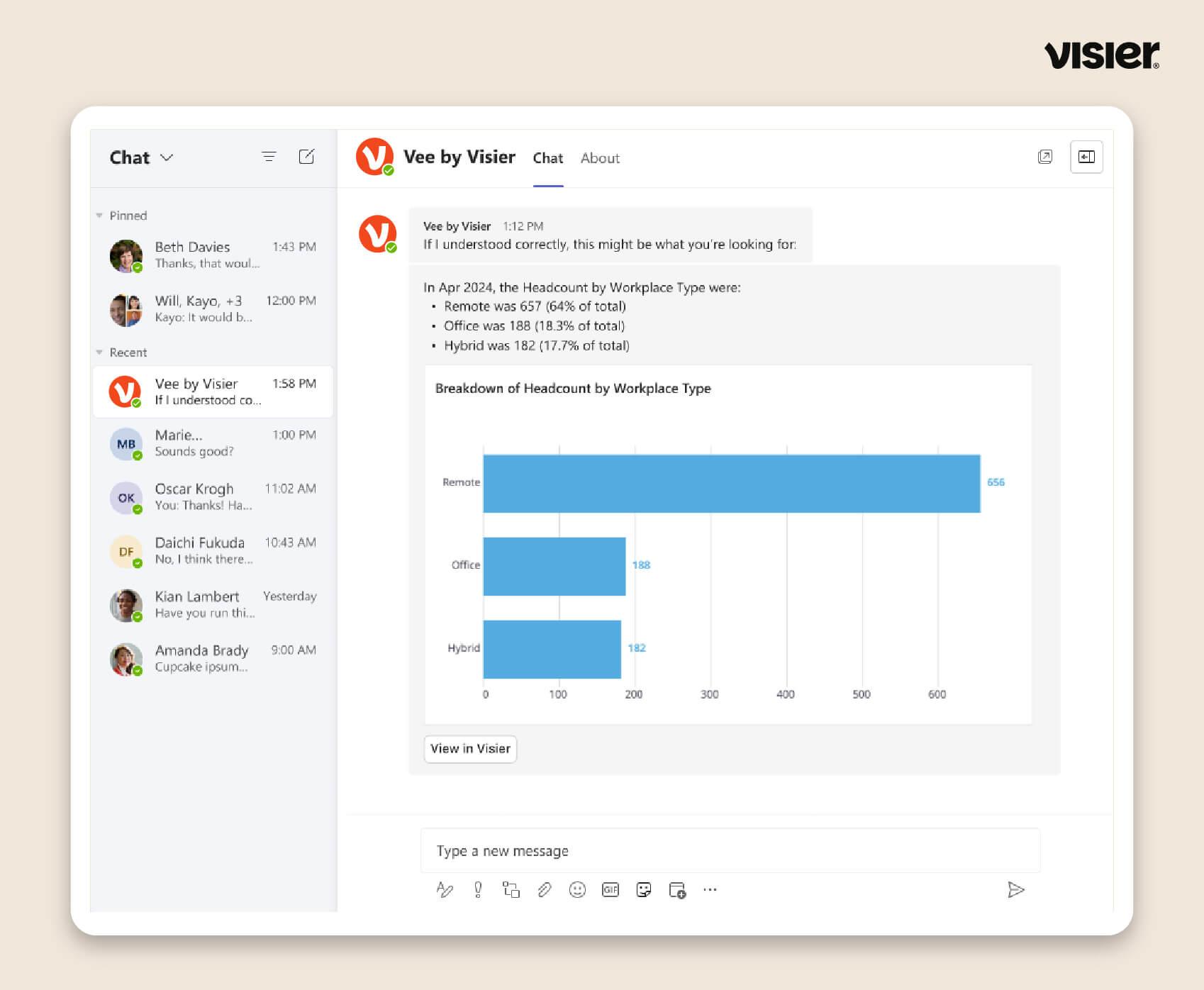
In addition to using Vee inside Visier People, organizations can ask Vee questions in the flow of their daily work through our integration with Microsoft Teams, Slack, and other enterprise tools.
Managers throughout the organization can get insights about their teams and departments without going into Visier People, simply by asking within the tools they already know.
"Vee is the future. It's a technology that we absolutely need. It's a game changer for the less tech-savvy to access people insights, like frontline managers who can ask a simple question in Microsoft Teams about their turnover and get an immediate answer instead of coming to the people analytics team."
Sameer Raut, vice president of HRIS, Sunstate Equipment
Vee also works in Microsoft Copilot. Users can get workforce answers inside the Microsoft 365 apps they use every day, add Visier content to an email or document in one click, and generate full, editable reports from their people data. In Slack, a native integration delivers answers live in the flow of work as questions come up.
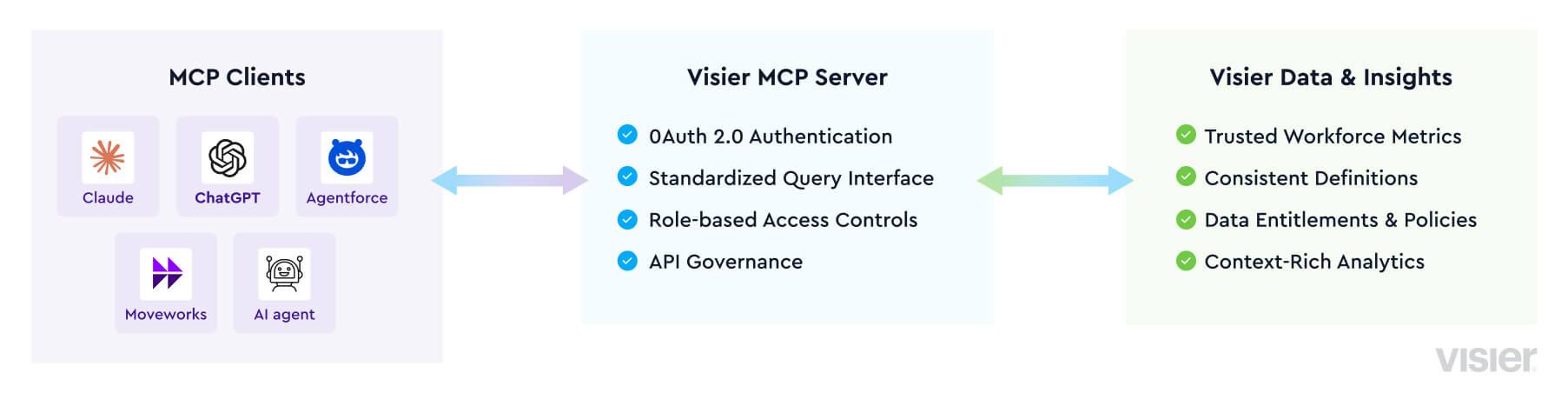
Through the Visier MCP Server, Vee connects to the AI agents your organization is already building and using. Visier's permission model carries through MCP, so users only see what they're authorized to see.
Vee is fine-tuned to your organization's commonly used terms. In a retail organization, for example, you might configure Vee to understand that "associates," "store workers," and "blue vests" are all synonyms for a specific category of employee.
Synonyms like these are set up in the Vee administration panel, so anyone chatting with Vee can use the language they already use every day. Admins can also upload instructions and documents to refine Vee's answers.
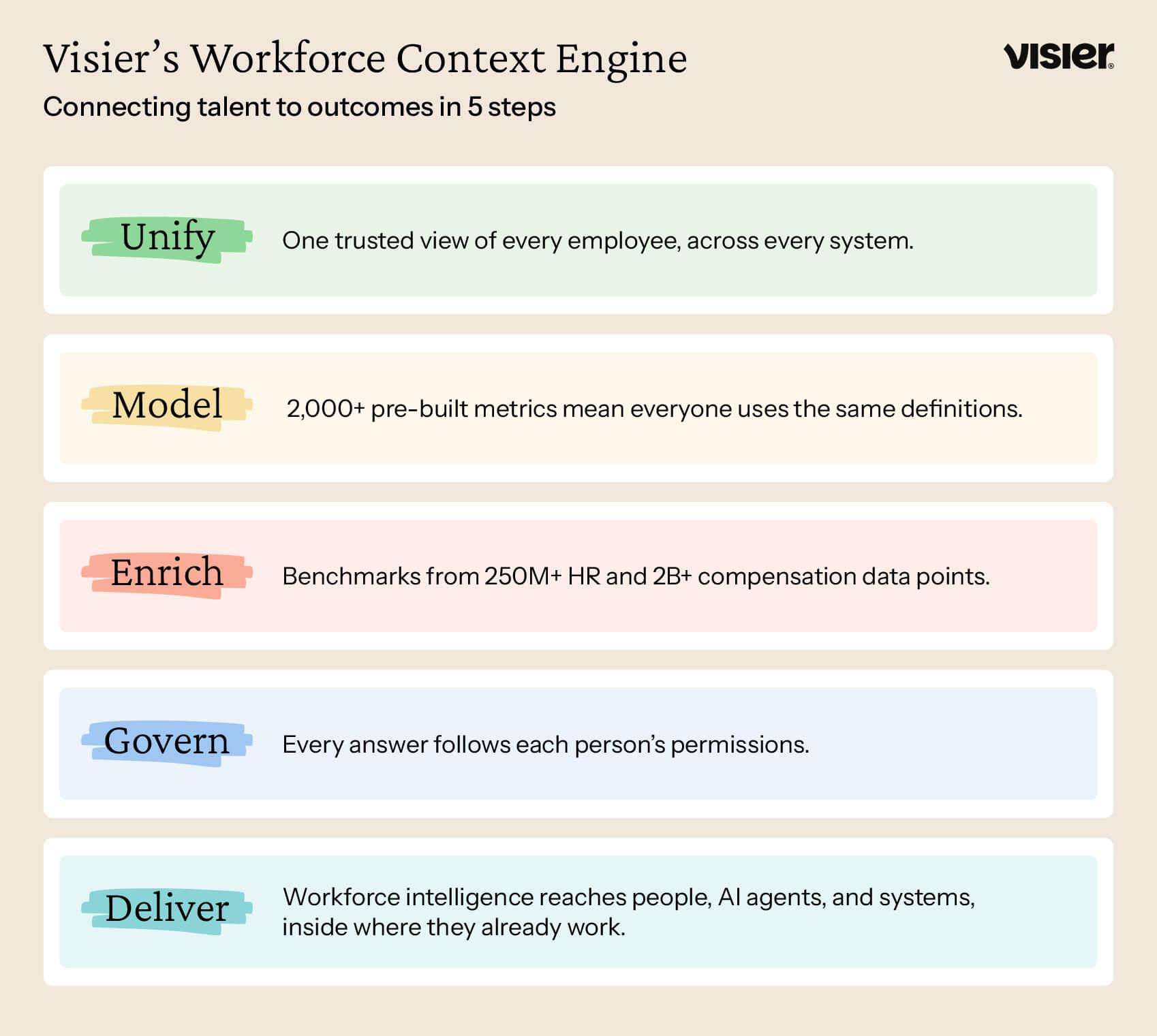
Generative AI is only as good as the context behind it. Workforce context is the meaning, timing, relationships, and permissions surrounding your people data. General-purpose AI models don't have it.
Vee draws its context from the Visier Workforce Context Engine, built on our proprietary model. The engine unifies data from Workday, SuccessFactors, Oracle HCM, and 20+ other systems. It applies 2,000+ governed metric definitions, so "active employee" means the same thing everywhere it's used. It also resolves each metric for any point in time, so "attrition by manager last quarter" reflects who was actually leading each team then, not today's org chart.
That groundwork matters. Leaders from AbbVie, Corning, and UW Health have found that definitions, ownership, and trust must be settled before any AI answer about the workforce can be relied on. The Workforce Context Engine handles that work, so Vee's answers rest on governed data rather than guesswork.
General-purpose AI tools draw on public information and have no permission controls for sensitive workforce data. Building generative AI for enterprise organizations is a different challenge, because much of the underlying data is private and, in some cases, highly sensitive. A robust security model must be at the core of any solution.
Vee is governed by Visier's advanced security model and permissions, so results are returned only to authorized users based on their assigned security model and permissions. Vee's answers from one person to another, while both accurate, will be different. Every answer also has full lineage, so you can audit and prove the methodology and data sources behind it.
Visier can move up or down the organization with ease, responding to a query about an individual employee or summarizing insights about tens of thousands of employees almost instantly. Generative AI works best as a continuous conversation, and Vee keeps pace without waiting for slow reports to run.
Have an application or workflow you want to enable with a conversational interface? The services behind Vee are part of Visier's Workforce Intelligence platform, the real-time people data platform behind Visier Workforce AI. Use APIs or MCP to power your own apps, chatbots, and AI agents with trusted people insights.
Get a demo to see how Vee can complement your people analytics practice.
AI in HR is the use of artificial intelligence, including generative AI and AI agents, to support HR work such as answering workforce questions, analyzing people data, and guiding decisions. It's only as reliable as the workforce data, definitions, and security controls behind it.
Vee is Visier's AI agent for people analytics. It answers workforce questions in plain language, with charts and the "why" behind each insight, using your organization's own people data and 2,000+ pre-built metrics. It works in Visier, Microsoft Teams, Microsoft Copilot, and Slack.
Generative AI in HR is commonly used to answer workforce questions, summarize people data, draft content, and support HR service delivery. With Vee, HR leaders, HRBPs, and managers ask questions such as "What's driving attrition on my team?" and get answers grounded in governed workforce data.
It can be, if the AI enforces access controls and keeps data private. Vee applies Visier's role-based security to every answer, so users see only what they're authorized to see. Customer data isn't passed to or retained by the LLM, and every answer is traceable to its data sources.
General-purpose LLMs lack shared metric definitions, point-in-time org structures, permission controls, and audit trails, so they can produce confident answers that are wrong or expose sensitive data. A workforce context engine supplies that missing context, so answers are accurate, governed, and defensible.
Yes. Vee has native integrations for Microsoft Teams, Microsoft Copilot, and Slack, so managers can ask workforce questions in the tools they already use, without logging into a separate analytics platform.
(Microsoft Teams and Microsoft Copilot are trademarks of the Microsoft group of companies. Slack is a trademark of Slack Technologies, LLC.)