
PREVENT REGRETTABLE ATTRITION WITH VISIER WORKFORCE AI
See and respond to attrition risk. Before it becomes attrition rate.
Get the full picture and tailored guidance you need to prevent top talent from leaving

Trusted by 85,000+ complex organizations














You can’t afford to lose them. But you still do.
Tracking attrition rate hides what leaders need to see about individual risk
Data blindspots
You only know that a person left, not why or how much their departure cost.

Blanket plans
Retention budget goes to programs that are easier to run rather than targeted where risk is highest.

Spotty followup
Where flight risk is identified, addressing it depends on limited HRBP capacity, with little to no visibility on business impact.

Disruption
When attrition hits critical capabilities, questions come down from legal, execs and the Board.
Change triggers uncertainty. Uncertainty triggers departures.
High performers leave first under restructuring and headcount freezes
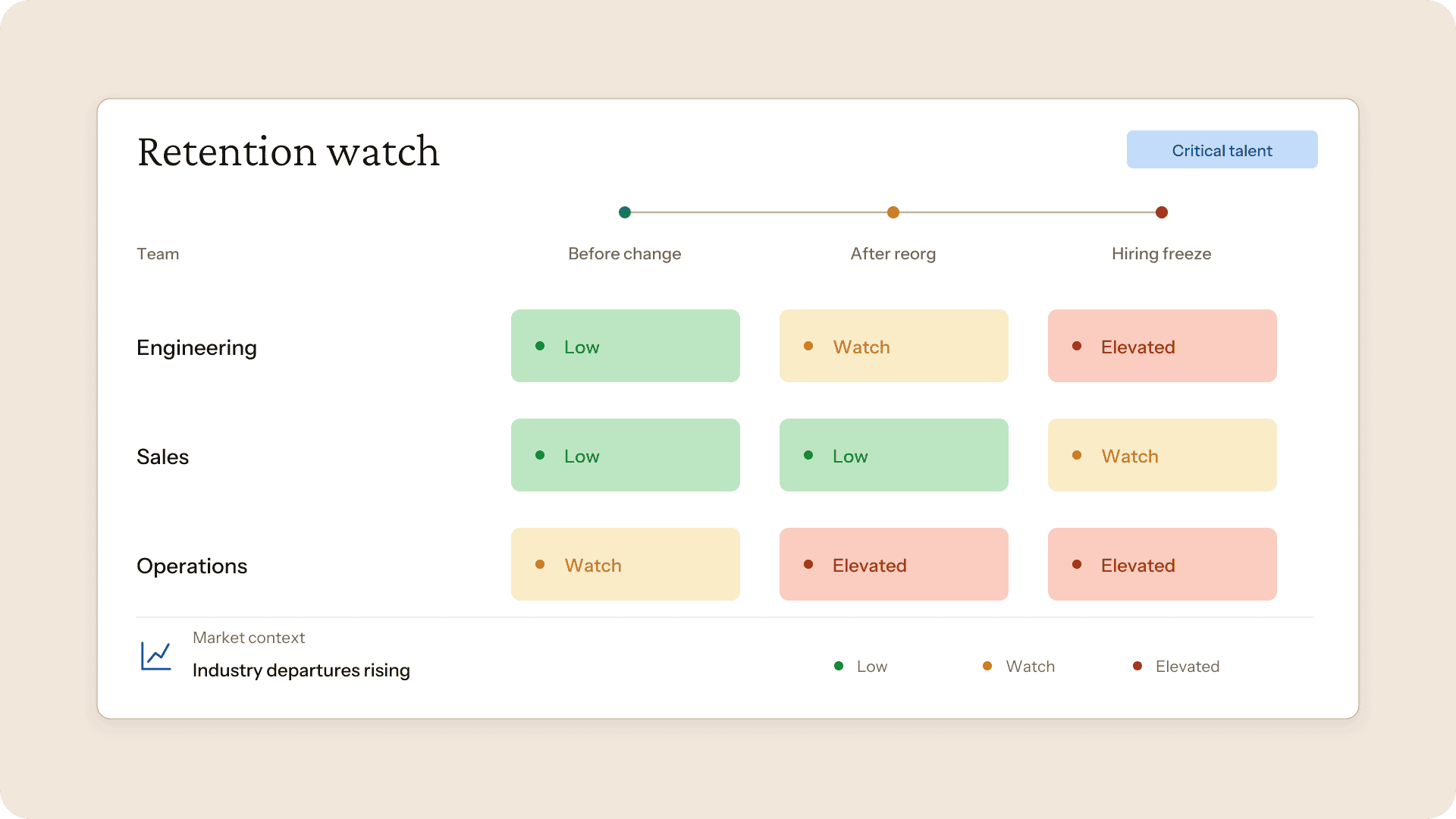
Orgs are reacting to increased demands on the workforce in light of AI. High turnover industries can’t keep up with regrettable attrition.
You need a way to track risk early. But your legacy systems prevent it.
Gap: A continuous picture of who is at risk right now, where there may be regulatory pressure and what is actually driving departures
Gap: Workforce context that can also identify macro trends in the market
These gaps are exactly what Visier Workforce AI was built to fill.
VISIER’S WORKFORCE INTELLIGENCE PLATFORM
For orgs that keep their best people
Built to identify risk early. Powered by 16 years of HR expertise.


Workforce intelligence compounds. It never resets.
Visier Workforce AI supports 3 interdependent functions.
 Understand
Get a real-time view of risk
Know who’s at risk, why they’re leaving and where pay is hurting retention.
 Plan
Know where to intervene
Decide which losses hurt and target retention investment directly where it will make a difference.
 Activate
Scale and track impact
Run retention programs across at-risk populations with manager guidance at scale. Prove what worked.
Powered by Visier’s proprietary Context Engine
Workforce context is the layer most orgs are missing

Decisions without corrections
Humans and AI understand impact, generate scenarios and roll out at scale

AI-powered insight
Follows set rules to reason on continuously-updating input

Visier’s proprietary Context Engine
Sets workforce-specific rules, definitions and guardrails. Unifies your people data.

Workforce data
Your people data, macro insights and HR science as raw input
ATTRITION
50% reduction
Sunstate Equipment reduced turnover by 50% by connecting headcount, overtime, and utilization data to catch flight risk before it became a resignation.
TURNOVER
33% reduction
Printpack identified and rolled out programs to its most at-risk population, reducing hourly staff turnover by 33%
RESIGNATION RATE
44% reduction
Visier customers reduced critical talent resignation rates by 44% after two years (double the general employee reduction)
People Analytics 101
Make Your Business Case for People Analytics
Get executive buy-in with a business case that connects workforce data to real results.

Governed, secure, makes IT happy






Common questions
Why isn't a standard turnover rate enough to manage this risk?
A turnover rate treats every departure the same, but losing a critical performer costs far more than losing someone in a role with backup. Without segmenting regrettable from non-regrettable and connecting it to replacement cost, the rate hides the information that actually matters.
Don't annual pay equity reviews already cover this?
Annual reviews are slow and legally fragile by the time they surface a gap. With pay transparency legislation expanding, employees now have external reference points, so a gap caught once a year has often already caused someone to leave or escalate.
How would we know who's at risk before they've already decided to leave?
Most organizations find out after the resignation, not before. Visier’s AI surfaces flight risk signals in pay, tenure, and manager history early enough to act, not explaining the departure afterward.
What happens if a manager doesn't follow through on an intervention?
That's the current failure point. Even correctly identified risk depends entirely on manager and HRBP follow-through today, with no visibility into whether the intervention even happened.
How do we prioritize retention spend without an unlimited budget?
Not every departure needs a fix, only the ones that damage the business. Investment built without a risk signal defaults to whichever program is easiest to run, not the population carrying the most cost.
Does this risk feeling like surveillance of specific employees?
The intent is protective, giving a manager the chance to intervene before a preventable loss, not building a file on someone.
Is our data clean enough to run this kind of analysis?
No organization's data is perfectly clean, and running the analysis only once a year is what lets gaps compound undetected. Continuous analysis is meant to improve as it runs, not require perfection upfront.
Will this add another manual process for HR Ops to maintain?
It's meant to augment your existing cycle with a continuous, governed view, reducing manual reconciliation rather than replacing it.