
Webinar
HR Leaders: How to Turn Workforce Intelligence Into Better Business Decisions
Published:
HR data is unlike almost any other data your organization holds—volatile, legally sensitive, and deeply contextual. Most AI deployments treat it like any other data source and pay the price. Here's what the architecture actually needs: a context layer, durable guardrails, and a semantic foundation that travels with the data wherever it goes.
· 7M Read
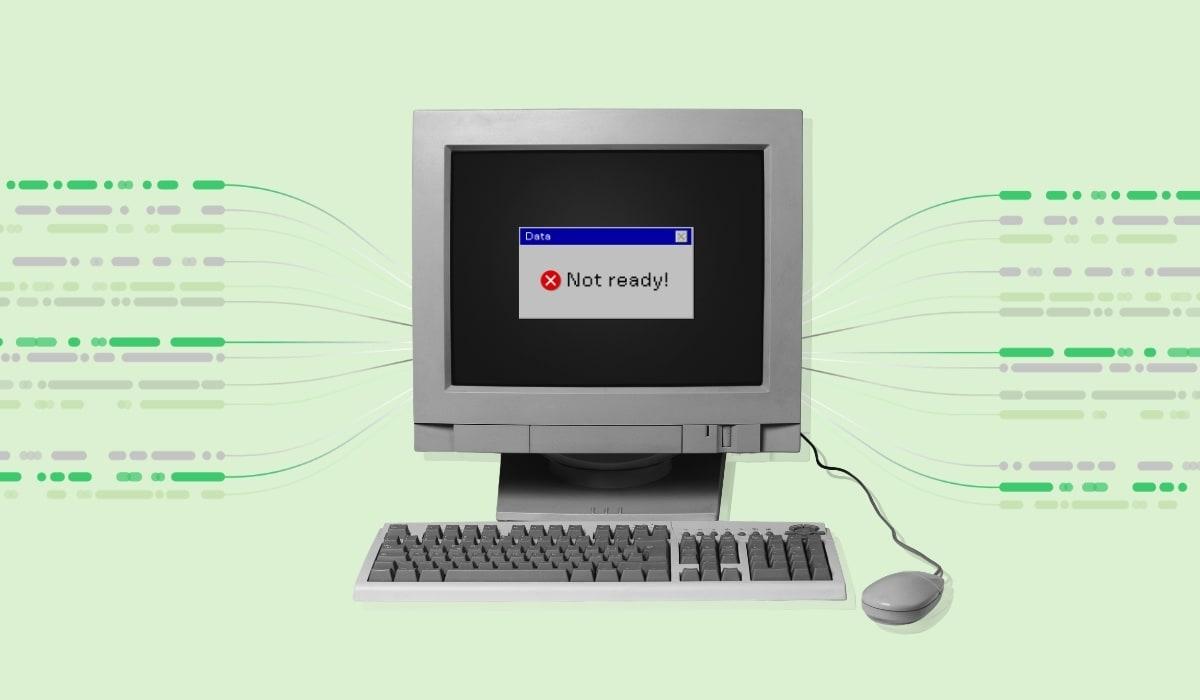
At some point in the last year, you’ve probably heard someone in your organization say, "Why don't we just load all that data into ChatGPT?" And it can start small. A few HR data tables here and there. A “quick” spreadsheet analysis. What’s the harm?
The problem is that HR data is unlike almost any other data your organization holds. It's volatile, temporal, and the need for security and governance carries serious legal weight. What’s more, terms like retention, span of control, and flight risk mean completely different things depending on the specific context.
And a general-purpose LLM isn't built to handle any of that context or nuance. It will confidently throw out answers based on guesswork. At enterprise scale, that guesswork quickly turns into risk.
S&P Global (opens in a new tab) recently asked enterprise tech leaders where generative AI falls short. The top answers were data privacy and security, accuracy of responses, and system integration. Those aren't abstract concerns when the data is about your people.
I’ve spent more than a decade at Visier helping organizations build the data foundations that make workforce data AI-ready. In that time, the same architectural gaps show up again and again.
The issue is rarely the AI model itself. An old process with new technology is just an expensive old process. What breaks workforce data and AI isn’t the intelligence—it’s what sits underneath it.
Most organizations are doing one of two things with workforce data and AI. They're either keeping humans in the loop for everything—clicking, reviewing, approving—which is slow. Or, more commonly than anyone wants to admit, employees are already loading sensitive workforce data into general-purpose AI tools with no governance in place. We partner with organizations who want to get ahead of this with a secure, governed space like the one we provide.
The organizations getting this right are finding the middle ground. They’re pairing the speed and reasoning of AI with systems that are observable, governed, and purpose-built for the complexities of workforce data.
When the foundation underneath is solid, the AI on top actually delivers.
What makes the middle ground possible? A context layer that understands how your organization actually operates. Not just the raw numbers, but the relationships between them: who reports to whom, what your company actually means by "retention," how a reorg last quarter affects the numbers you're looking at today.
Without that layer, every answer your AI produces is a confident guess.
If you're evaluating AI tools for workforce decisions, the most important questions are about what sits underneath it all: the definitions, the governance, the time-based logic that makes a workforce answer trustworthy rather than just fast.
Raw HR data doesn't come with understanding attached. When a manager asks why engagement is dropping, the answer isn't in one number. It’s in the relationship between that number and a dozen others, filtered through the right time window, the right population, and however your company defines key terms.
That's the context layer's job. It brings together all your workforce data for a complete picture, models it with semantics so there's shared meaning, and distributes insights, answers, and guidance securely to whoever—or whatever—is asking. When someone says "engagement" or "retention," the system knows exactly what they mean at your organization, not what a general-purpose model might infer.
AI is only as trustworthy as the context behind it, but in order to get that context, you need a context engine that brings together all your workforce data into a complete picture. It also has to model it with semantics so there's meaning, and then securely distribute insights and answers back out.
This is where Model Context Protocol (MCP) fits in. MCP is a standardized way to get those governed answers out to AI agents and the humans using them. By connecting to the same workforce context through MCP, every tool and every user pulls from the same place—the same definitions, the same security rules, the same logic. When a manager asks a workforce question in Teams and an analyst asks the same question in their analytics platform, they get the same answer. Not because the tools are integrated with each other, but because they're both drawing from one governed source.As Steve Holder, our COO, put it at Visier's Outsmart conference earlier this year:
“Ask an AI agent what your retention rate is, and it will give you an answer. But whether that answer reflects your company's definition of retention—your time windows, your population exclusions, your internal logic—is a different question entirely. That's the gap a fully governed context layer closes."
In almost every discussion I have around the context layer, someone asks: why can't we just build this ourselves? After all, the context layer covers the breadth of knowledge, definitions, and logic that the organization theoretically already holds internally.
Yet, the workforce context layer isn't a data schema your engineering team pulls together in a few months. Years of accumulated knowledge go into defining how workforce concepts connect to business outcomes.
It's expertise that only comes from working across hundreds of organizations, seeing where the models break, fixing them, and doing it again.
The kind of time-based logic that breaks standard SQL pipelines (backdated promotions, retroactive corrections, and mid-year reorganizations) has been solved already. But most teams don't stumble into these technical challenges until they're six months into building it themselves.
A workforce context engine doesn't replace your existing tech stack. It takes on the hard, undifferentiated work of making workforce data trustworthy so the rest of your stack doesn't have to. The semantic modeling, the temporal logic, the governance—that's already handled. Visier's Databricks integration is a good example. Databricks handles unified storage, compute, and governance. Visier sits on top as the workforce data layer, applying workforce-specific semantics and surfacing enriched data products back to the lakehouse or directly to AI agents via MCP. Your team's time is better spent on the work that matters.
Your team’s time is better spent on the work that matters.
Capability gets all the attention in AI deployments: what the system can do, how fast it answers, how smart it sounds. But none of that matters until governance turns it into something an organization can actually put to use, rather than just possess.
According to IBM (opens in a new tab), 63% of organizations that experienced an AI-related breach either had no governance policy or were still drafting one.
The organizations scaling agentic AI safely aren't just locking capability down. They're directing it, deciding what it's for, where it applies, and where it stops. It's a conversation I'm already having with teams at Microsoft, AWS, Anthropic, and OpenAI.
Before deploying any agentic capability, I’d push on four questions:
What guardrails are needed? The answer is always use-case specific. An agent surfacing insights to managers needs different constraints than one supporting HR business partners or executive planning.
How are they implemented? This is an architectural question that has to be answered at the context layer, not bolted on afterward. Guardrails applied at the model level are fragile. Guardrails embedded in governed data access and semantic definitions are durable.
How are they tested? This is the question most organizations aren't asking yet. Guardrail testing requires adversarial thinking—probing the system with the kinds of questions that should be rejected to confirm they actually are.
How does the iteration process work as the use case evolves? The right guardrails for an early pilot are almost certainly not the right guardrails six months later. Build the iteration process from the start.
What all of this points to is a layer that handles the context, governance, and semantic grounding that AI on workforce data requires, built in from the start rather than configured on top.
At Visier, we've spent 15 years building with our customers toward this moment. That history means the data our customers rely on is unified, enriched, and governed to deliver accurate workforce context to any tool, AI agent, or human asking a workforce question.
That's what we call the Workforce Context Engine, and it's what makes the difference between AI that sounds right and AI you can actually trust.
Discover how Visier's Workforce Intelligence Platform turns messy, complex HR data into governed, AI-ready insights. See what workforce transformation looks like.
![[featured resource] strategic-workforce-planning-ai-era](/_next/image/?url=https%3A%2F%2Fimages.ctfassets.net%2F3geimt851116%2F1Z3UoMR1C6vfcYRCZUJYbX%2F71a9de51a9902d704ff6d6be0c5e4af9%2FStrategicWorkforcePlanning-DownloadImage-576x411.jpg&w=3840&q=75)
