
5 Workforce Transformation Lessons From PETRONAS
Dashboards don’t transform a workforce, but decisions do. PETRONAS’ Head of Global HR Services explains how they balance technology, data, and human judgment at enterprise scale.
· 7M Read

Many HR and Workforce Planning leaders have felt the pain that comes with fragmented, delayed data. You’re expected to guide strategic decisions, but you spend half of your meetings arguing over whether the data is accurate and what numbers are up to date.
These are the frustrations I routinely hear about in conversations with global HR leaders. And while new technology is often seen as the fix, that can be difficult to adopt at enterprise scale—and get it right.
But that’s exactly what Naina Mohd Shukri Omar, Senior General Manager of Global HR Services, has been working on at PETRONAS: finding the balance between tech adoption, workforce productivity, and people management that will lead to real workforce transformation.
I sat in on the fireside chat with En Naina alongside Jackson Teng, Senior Director of Asia Talent Acquisition & Workforce Strategies at Micron, at Outsmart Local: Singapore. In the discussion, I learned exactly how Naina is actually approaching these challenges head-on.
PETRONAS’ Three workforce strategy pillars
PETRONAS is Malaysia’s fully integrated global energy solutions provider with over 100+ entities. En Naina described the team as having one job: making HR work better for people and for the business.
To do so, they’re focusing on three things with their workforce strategy:
Workforce transformation
Technology adoption
All of these things are setting the stage for what En Naina called “PETRONAS 2.0”:
“The aim is for us to be stronger, competitive, agile, and also future-ready. Especially with the current situation: the energy landscape is changing, and technology is coming in. The expectation from the employees is also getting higher and higher. Over and above that, we need to monitor costs and deliver value…It is not so much doing more with less, but really focusing on the people and the skills who will be able to drive the business [forward].”
5 takeaways from PETRONAS on enterprise-scale workforce transformation
In my experience, that’s where most businesses are sitting right now: the landscape and technology are changing fast, but there’s still an immense pressure to deliver value while reducing costs.
After listening to the Outsmart discussion, I came away with these takeaways from En Naina—which are immediately applicable for other HR teams working through these same challenges:
1. Business first, technology second
In a race to keep up with the speed of technological change, implementing any new technology can feel like a win.
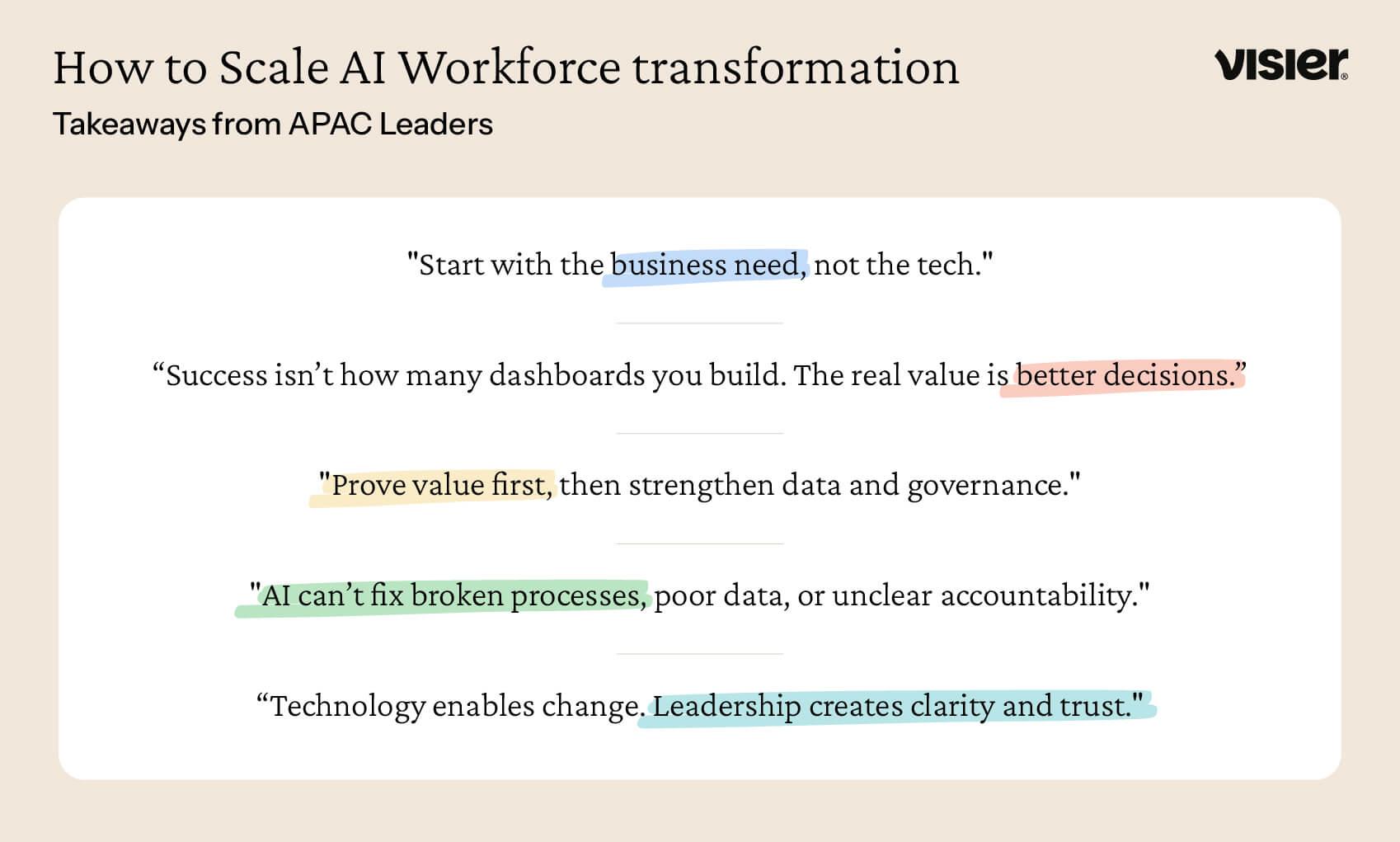
Not so, says En Naina. Transformation should start with the business need, not the technology. The best way to integrate new technology is to build capabilities around the business needs, rather than trying to shoehorn a new technology into your business without a plan.
En Naina also notes that the biggest change often isn't technology at all: it’s the mindset shift that has to happen among your workforce. Even if the technology is a perfect match for the direction of the organization, it will fail to launch if employees are not prepped and primed to integrate it into their daily workflow.
2. Dashboards aren't the outcome
Creating another dashboard feels like an easy win: the data is shared, organized, and the insights are right there.
But dashboards are not the outcome, En Naina reminded us; decisions are.
“Success is not about how many dashboards that you build. Success is when that data or insight leads you to better decision-making.”
The real value of analytics doesn’t come from a number or a fancy presentation. The value only comes when the numbers lead to smarter workforce decisions and measurable business outcomes.
As En Naina points out, to evolve beyond the dashboard is to move from a focus on what the data says to what the data means. Then, deciding what we should do about it.
"We shift from the discussion of whether we have the right number or not, and it moves to: What does this mean? From 'What is the data?' to 'What do we do with that data?' We used to be pulling a report. But now we’re deciding what needs to be done.”
3. Start small, fix data as you go
As En Naina reminded us at Outsmart about any workforce transformation: Progress over perfection.
Of course, data quality is important. Because if you start with bad data, you’ll lose trust before you’ve even gotten the project off the ground. But there’s a whole world in between bad data and perfect data, and it’s far too easy to get stuck chasing perfection.
When rolling out new technology at PETRONAS, En Naina’s approach is to start small. His goal within a small pilot is always to fix the data while still moving forward and still delivering value.
“We choose important use cases so that we can show the value early, and it also builds up the confidence step by step,” En Naina explained. “Every rollout is really a chance for us to check the data, its governance, and to earn trust from the stakeholders.”
As the value of data-driven workforce decisions becomes visible, confidence grows among your team and with the C-suite. That buy-in funds the next round of data improvement.
In short: start small, learn fast, improve your data, then scale. Quick wins create momentum. Momentum creates buy-in. Buy-in lets you scale.
4. Build the foundation before introducing AI
PETRONAS is working on bringing the best out of both humans and technology. It’s a value-first approach: humans may not be able to move as fast or analyze data like AI can, but AI can’t fix broken processes, bad data, or leadership accountability.
Ultimately, their approach to introducing AI comes down to one rule: Foundation before acceleration.
When thinking about how to introduce or accelerate AI (or any technology), En Naina asks three questions:
Are we solving the right business problem?
Do we trust the data?
Is there clear value at the end of it?
After all, if you’re not solving the right business problems, great data means nothing. And if you’re solving the right problems, but you don’t trust the data, insights won’t be valuable.
Finally, when it comes to value, AI needs to give clear value to everyone involved:
“At the end of the day, when we apply AI, for example, it has to give value to the employees, leaders, and also the business. It has to improve or strengthen decision-making, productivity, and the employee experience. Technology should follow the business, not the business following technology.”
By building a foundation that centers business outcomes first, you can be confident that you’re investing in technology that actually delivers long-term value.
5. Lead through uncertainty
Sometimes it feels like the hardest part of implementing new technology isn’t figuring out where or how to use the tech, but getting the team on board and fully adjusted to the new process. But En Naina wisely pointed out:
“Our realization when it comes to this journey is that people are rarely resisting technology… but what they actually struggle with is uncertainty with technology. Of course, people have questions about technology. But more so, people have deeply human questions. ”
Technology creates change, and leadership’s role is to create clarity on what is changing and why it matters.
It’s on us as leaders to create clarity, trust, and adoption when we implement new technology. The more clarity we can give our teams (How will this impact me? What does this mean for my role? Will this make me more successful?), the easier it will be to build trust, team alignment, and broader enterprise-wide adoption.
Our own research backs this up. In Visier’s 2026 AI employee pulse poll, 59% of employees said their employer doesn’t have a clear plan for how AI will affect their jobs. When employees were asked what would raise their confidence, job protection wasn’t the top answer. Instead, they asked for more AI training and upskilling (32%) and, a very close second, more transparency and clarity from leadership (31%).
Workforce transformation: When technology, data, and human judgment work together
If there’s one thing I’m going to take away from this session, it’s this: leadership’s role is to make sure that technology is adopted purposefully.
En Naina summed it up this way:
“Technology alone can’t create value, even with AI. AI will add value when it strengthens decisions, empowers people, and ultimately, business outcomes. The successful future companies are not necessarily the companies that have the most advanced technology, but the ones that combine three things: technology, data, and human judgement.”
What I took from En Naina’s work at PETRONAS is that technology can reshape work while data reshapes decisions, but it’s still up to us as leaders to shape the outcomes.
Let business outcomes drive your technology adoption
Want more support in leading the workforce transformation strategy at your organization? Explore the data, tools, and emerging trends shaping today’s workplace in the Workforce Transformation Hub.