eBook
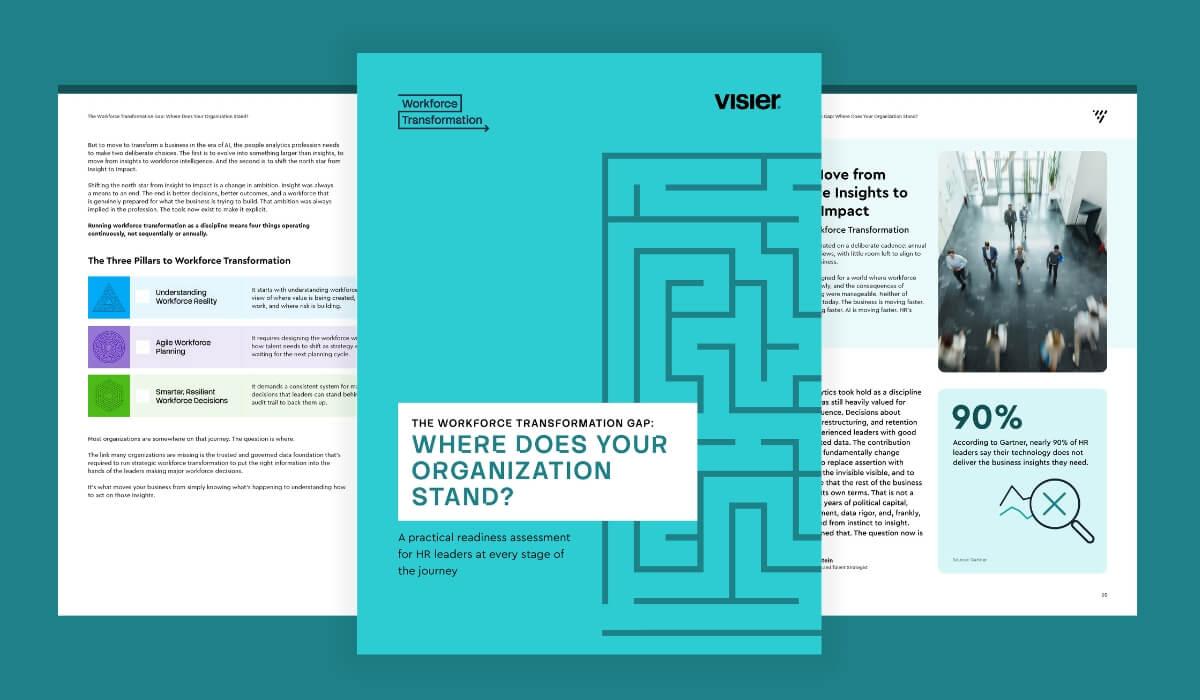
The Workforce Transformation Gap: Where Does Your Organization Stand?
Published:
The Workforce Transformation Gap is a widening gap between the speed at which workforce strategy needs to move and the operating models most organizations are still relying on to run it. This is how to close it.
· 3M Read
Look around you. Something has changed.
AI isn't just changing how we get insight. It's changing the workforce itself. Organizations are already redesigning how work gets done, who does it, and what leaders are actually accountable for.
But while business strategies are evolving at AI speed, workforce decisions still move at spreadsheet speed.
That used to be OK. Organizations once had the luxury of time to course-correct 90 days after a decision was made, trusting that annual planning cycles and periodic reviews would be enough to keep them on track. But when ChatGPT launched in 2022, kicking off an AI-driven workforce transformation, that window closed.
The Workforce Transformation Gap is a widening gap between the speed at which workforce strategy needs to move and the tools and operating models most organizations are still relying on to run it.
Once-a-year planning cycles, fragmented visibility across workforce supply and demand, and the persistent silos between teams no longer fit the reality of how businesses need to operate. These characteristics are increasingly becoming strategic liabilities, and they fall squarely in HR's domain to solve.
And while it's true HR has always been positioned to lead the workforce transformation conversation, what's changed is whether that leadership has the right infrastructure to back it up.
In years past, HR made the transition from acting on instinct to acting on insight, replacing gut decisions with evidence and data, making workforce dynamics visible, and earning a seat at the strategy table. That was the hard-won progress of the people analytics era.
But that insight isn't enough anymore. The business now needs HR to move from insight to impact: to connect workforce decisions directly to outcomes, in real time, and to run that as a continuous discipline rather than a once-a-year exercise.
For the organizations navigating workforce transformation well, the traditional boundaries of HR are already shifting. Workforce planning, finance, IT, and AI governance are converging into something new, and businesses are demanding that workforce strategy be visible, defensible, and tied to outcomes in real time.
And yet, some organizations are trying to navigate this transformation without its most critical asset: the workforce data and context HR holds. They treat workforce transformation as the same-old annual initiative rather than the always-on operating discipline it must become.
To right the ship, HR needs to lead with the right intelligence foundation—one that is trusted, visible, and actionable across the entire organization.
Organizations are quickly learning that workforce transformation doesn't happen during an isolated project or a one-off event. And laying the groundwork requires more than just a single technology or a one-time data cleanup.
Successful, ongoing workforce transformation requires the context that connects workforce reality to business strategy in order to give leaders a live, governed view of where value is being created, where AI is changing work, and where the risk lies.
The organizations that lead through this moment are the ones with the systems and teams that support the full journey: a shared foundation that gives HR, finance, IT, and executive leadership one source of truth on their workforce, and the confidence to act on it decisively.
The good news? The shift from reactive to proactive, from insights to impact, is within reach.
See how to move from reactive decision-making to confident, data-driven transformation—with resources covering organization design, workforce planning, and people analytics.
Research, frameworks, and real-world stories to help you navigate what's next.