
HR Digital Transformation: From Platform Owner to Architect
Global leaders from Edgewell, athenahealth, Vertex, and more, on the three shifts HR tech leaders must make to become workforce transformation architects.
· 5M Read

The job description for HR has changed. HR used to simply own the platforms, but that’s not enough anymore. In this new era of work, driven by rapid advances and integration of AI, HR must step up as the architects of workforce transformation.
This means HR must move from distilling insights to making measurable impact; from operating as a system of record to a system of possibilities. Achieving this goal will require leaders to break habits they’ve built over the past decade. The good news? Breaking these habits—in the right ways, of course—will lead to a fundamental HR digital transformation.
I had the opportunity to explore this fundamental shift during the HR Leaders Workforce Transformation Summit. Across the panel of global HR leaders, I heard alignment on HR's new trajectory. Here are the three big takeaways I pulled from the discussion.
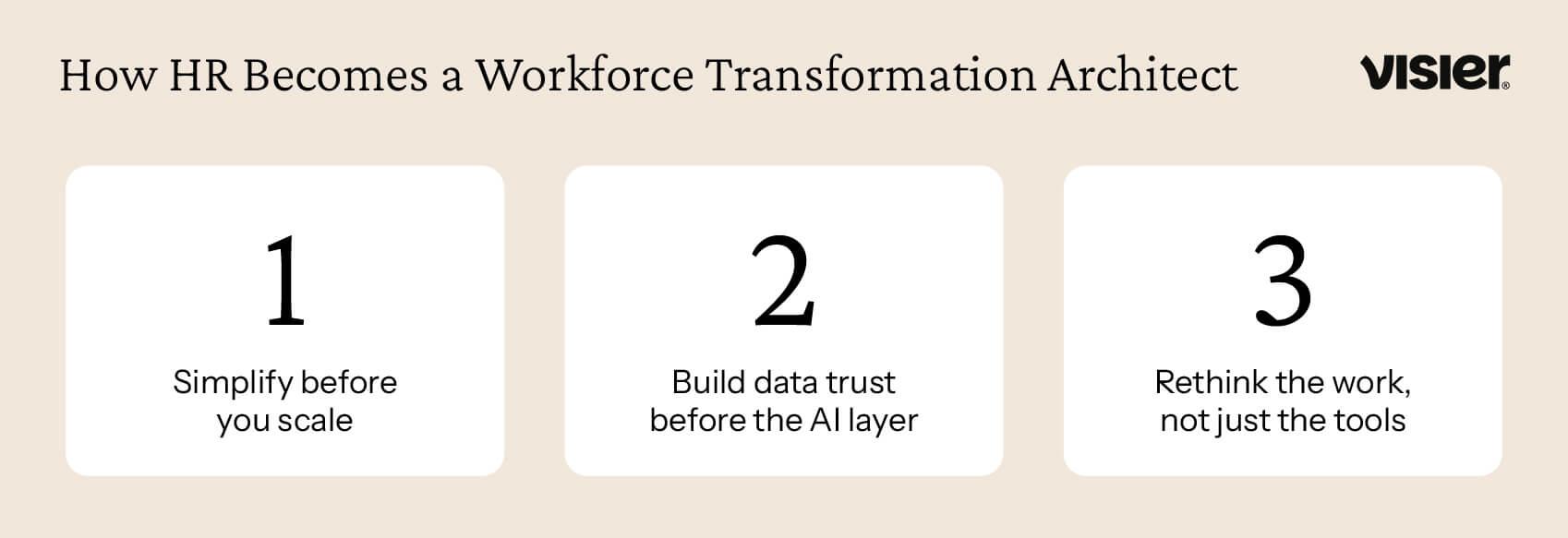
How HR Becomes a Workforce Transformation Architect
Simplify before you scale
Build data trust before the AI layer
Rethink the work, not just the tools
1. Simplify before you scale
Most HR tech leaders try to automate their way through complex problems. Resist that impulse!
As Arun Serikar, the VP of HR technology, digital platforms, and AI innovation at Schneider Electric, said, “If we continue to automate the mess, you're just making it more and more visible.”
Instead, he prompted, “If something’s taking 30 hours, the first question is, why is it taking 30 hours?"
In other words, we need to fix problems before we automate processes. Just imagine how much more efficient your team would be if you turned a 30-hour process into a 15-hour process, then automated the entire operation.
The same rule applies to software tools. If you’re not careful, you’ll end up with a dozen tools that solve a dozen narrow problems, and for your employees that means they need to learn a dozen new software skills. Complexities add room for error, so what if there was just one coherent experience?
Tech-stack simplification is front and center for Chakkry Arunachalam, the head of HR data strategy, people analytics, and digital innovation at Vertex Pharmaceuticals.
In his opinion, “Irrespective of how many tools [...], you have one digital front door. So it makes a lot of sense,”—for employees, company-wide adoption, and even the decision-making process.
Your employees don’t need to know which system does which job behind the scenes. They need a single entry point that will give them the answers they’re looking for, and do so quickly with little to no friction.
2. Build the trust foundation before you build the AI layer
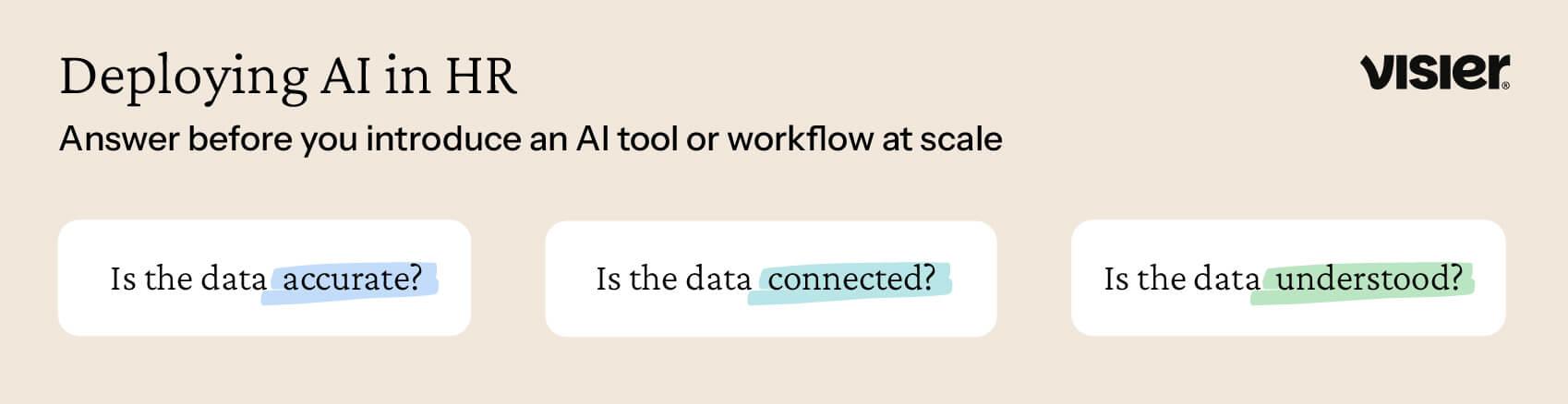
Unfortunately for HR tech leaders, AI doesn’t automatically create trust. Instead, it amplifies what already exists in your organization's workforce data, good or bad.
Because of this, you must answer these three questions honestly before you deploy an AI tool or workflow at scale:
Is the data connected?
Is the data understood?
As Colin Emery, the global director of HR systems, data governance, and people analytics at Edgewell Personal Care, said, “If you can't tick all three, you're not going to get any workforce intelligence that's valuable. We're really starting to create workforce confusion."
Think about it like this: You don’t question your GPS’s algorithm because you trust the map it’s built on is accurate. But if the map is wrong, even the world’s most advanced GPS app will drive you over a cliff. The same principle applies to HR data.
So many organizations rush to implement AI, but they’re doing so on top of fragmented data. If your employee, skills, recruiting, and workforce planning data isn’t accurate, the AI you implement will only sow distrust throughout your company.
Before you dive into AI platforms and workflows, architect a single workforce reality that ensures commonality between data definitions, governance rules, and data relationships across your organization. Doing so will give company leadership a strong reason to trust your insights.
3. Rethink the work, not just the tools
Finally, automating for the sake of automating is a real and growing problem.
Too many HR departments have failed to ask critical questions like, “What decisions do we need to make faster?” and “What does the business actually need us to answer?”
Jessica Thornton, the director of people analytics at athenahealth, said, "As we bring in new technology, we don't just have to do the same thing in a digital format... It can change the way that work happens, and so we have the opportunity to rethink a lot of workflows."
It’s also important to remember that the way we measure success should change as we introduce new tools. Instead of asking, “Did the system work as we designed it?” ask, “Did my department—and the organization as a whole—make better decisions because of the system?”
Ultimately, AI and automation allow you to redesign work, but it won’t do the redesign for you. You need an HR transformation architect to take the wheel, ask which workflows need an overhaul, and have the confidence to decide which workflows must be left alone.
HR tech leaders already making the shift from platform owner to architect
The HR tech leaders who move from platform owner to workforce transformation architect simplify their workflows before they scale them, build trust in their data before they layer AI on top of it, and apply AI as a means to change the work rather than speed up old processes.
The teams on this panel are already doing it, in industries with real constraints and no appetite for experiments that don't pay off. None of it required a checklist of systems to implement. It took the discipline to slow down, simplify, and fix what was broken before scaling it up to the speed of AI.
To achieve true HR digital transformation and architect your company’s future, you need to do the same.
Ready to evolve your role into a workforce transformation architect?
Our resources hub helps you move from reactive restructuring to confident, data-driven transformation for your organization's design, workforce planning, and people analytics needs.