Guide
Maximizing Workforce Productivity & Performance: The Role of AI
Published:
Visier Research surveyed 50 business leaders outside HR to uncover the workforce productivity statistics that matter most: how executives define productivity, and which metrics they're missing. Biggest takeaway? 65% say inefficient processes—not bad data—are the biggest obstacle.
· 8M Read

Ask 10 executives to define "productivity," and you'll get 10 different answers. Some point to output while others point to revenue. Still other leaders will focus on whether a project shipped on time and on budget.
Visier Research set out to find the pattern underneath those answers about workforce productivity. In March 2025, we surveyed 50 non-HR business executives. That meant the people who set strategy and own the P&L, not the people nerds who typically build the workforce dashboards. We wanted to find out how they think about workforce productivity, what data they trust, and what prevents them from making data-informed workforce decisions.
The results of our survey uncovered that business leaders trust the concept of data more than they trust the actual outcomes. For example, 60% of our survey respondents called workforce data critical, yet only 24% are very confident their workforce will actually be productive this year.
Clearly, this is a business population that values workforce data in principle, yet struggles with broken processes in practice. This article breaks down what we found, in the executives' own words.
In mid-March 2025, Visier Research surveyed 50 business leaders operating outside of HR about how they think about workforce productivity. We deliberately excluded HR respondents to capture an unfiltered, operator's view of productivity because we wanted to hear from the people who typically consume workforce data rather than those who produce it.
Respondents included CEOs, CFOs, CISOs, CMOs, and COOs, as well as SVPs and VPs of Customer Success, Operations, Product and Product Marketing, Sales, and Technology. Most respondents led organizations with 500 to 1,000 employees.
Business leaders defined productivity in terms of efficiency, goals, output, customer focus, and measurement.
Workforce data mattered to business leaders, but not to all of them equally.
Inefficient processes and workflows, not bad data, were defined as the biggest obstacle to productivity.
Employee output is the workforce productivity metric business leaders miss the most.
Output and efficiency are the KPIs that matter most to business leaders.
A security leader defines productivity around time and task completion. A revenue leader defines it around pipeline and closed deals. A technology leader defines it around delivery and budget.
There's no single company-wide definition of productivity. Instead, there's a set of definitions, one per function, that all need to feed the same workforce data strategy.
Here are the five themes that surfaced most in the survey responses:
Efficiency: the ability to achieve more with less waste of resources: time, effort, and money.
"Productivity is the amount of work you can do within a given amount of time to accomplish a task." —Joe, Chief Information Security Officer, 500–1,000 employees
2. Goals and objectives: the degree to which actions and effort contribute to specific targets and desired outcomes.
"I define productivity in terms of revenue-generating activities: number of emails, meetings, leads, opportunities, and closed revenue ultimately." —Mike, SVP Revenue Operations, 500–1,000 employees
3. Output and result: the quantity and quality of deliverables produced within a given timeframe.
"Meeting project deadlines. Delivering things on time and within budget. A project delivered on time but with extra resources is neither efficient nor productive." —Luis, Chief Technology Officer, 500–1,000 employees
4. Customer focus: the extent to which activities are directed toward meeting customer needs and improving customer experience.
"I define this by first measuring customer happiness, which allows what follows. My main focus is account expansion, product adoption, and driving loyalty through referenceable clients. If these items are being checked, I'm confident the team is being productive." —Ian, VP Revenue Operations, 500–1,000 employees
5. Measurement: the process of quantifying and assessing productivity through metrics and data.
"Productivity is ultimately a function of outputs, with our top metrics being pipeline, bookings, and revenue. Productivity is our ability to grow these metrics with stable to increasing efficiency." —Randy, Chief Marketing Officer, 500–1,000 employees
A few other characteristics also appeared across survey responses and are worth mentioning: task completion, revenue and growth, quality, process improvement, and prioritization.
60% of business leaders consider workforce data "extremely" or "very" important for improving productivity. But interestingly, our survey found that in general, senior IT, finance, and marketing leaders agreed with this idea more than sales or product leaders did.
That leaves 40% of business leaders who see workforce data as only moderately or slightly important.
For any organization trying to build a data-driven culture around workforce decisions, this is a gap to note. Do leaders need easier access to workforce data? Do they need more education around what is available, and how? What is preventing your leadership team from making the most use of workforce data for better decision-making?
When we asked what gets in the way of higher productivity, business leaders didn't point to their data first. They pointed to their processes.
65% cited inefficient processes and workflows as their biggest frustration.
30% cited challenges in accurately measuring productivity.
20% cited a lack of accurate data.
This suggests that long before organizations chase more workforce data or focus on cleaning up data, they need to fix the workflows the current data has to move through. Once the workflow gaps are visible, leaders will know if there is actually missing information or whether they have what they need to solve productivity issues.
Business leaders told us they're missing visibility into a specific set of signals:
Employee productivity & output
Employee skills & capabilities
Learning & training hours
eNPS/Satisfaction
Time, scheduling, & absenteeism
What really stood out in the survey responses is that business leaders need more than traditional HR metrics. They need metrics on operational and cross-functional signals. This is a reminder that workforce productivity data needs to connect to business data, not sit in a separate silo.
Asked which KPIs matter most to their view of productivity, business leaders' answers clustered into five categories:
Output and efficiency: number of tasks or projects completed, work output versus hours worked, employee utilization rate, and time to complete tasks or projects.
Revenue and financial impact: revenue per employee, pipeline generation and efficiency, ROI on camp: Customer Satisfaction Score (CSAT), Net Promoter Score (NPS), customer engagement rates, and number of customer interactions.
Project and task management: Meeting project timelines, task completion rates, time-to-market for new features or products, and cycle time for various processes.
Employee engagement: employee engagement scores, employee satisfaction, time spent on learning and development, and team collaboration and cross-functional contributions.
Several consensus points stand out from this Visier Research survey of non-HR leaders about workforce productivity—points which particularly pertain to HR and People Analytics leaders wanting to earn a seat at the decision-making table.
First, definitions of productivity vary by function, so a single company-wide productivity metric will satisfy no one. Workforce data strategies need to measure output, efficiency, and goals with a customer focus. Furthermore, the strategy has to measure all of these metrics simultaneously.
Second, the biggest opportunity to improve workforce intelligence on productivity sits in process, not data collection. Considering most orgs already sit on a mountain of data, the solution isn’t so much about collecting more. When 65% of business leaders point to workflow inefficiency as their top obstacle, the first step is to better connect people data to work data, so leaders can see where internal processes break down and productivity numbers fall.
Visier connects HR with the broader business by unifying people and work data to deliver AI-powered analytics and insights that drive business performance and can help solve workforce productivity challenges.
As a collaborative platform, it helps PA, HR, and non-HR leaders speak the same language and cite the same source of truth. By breaking down silos, it's easier to align on goals, in order for the business to finally make data-informed workforce decisions.
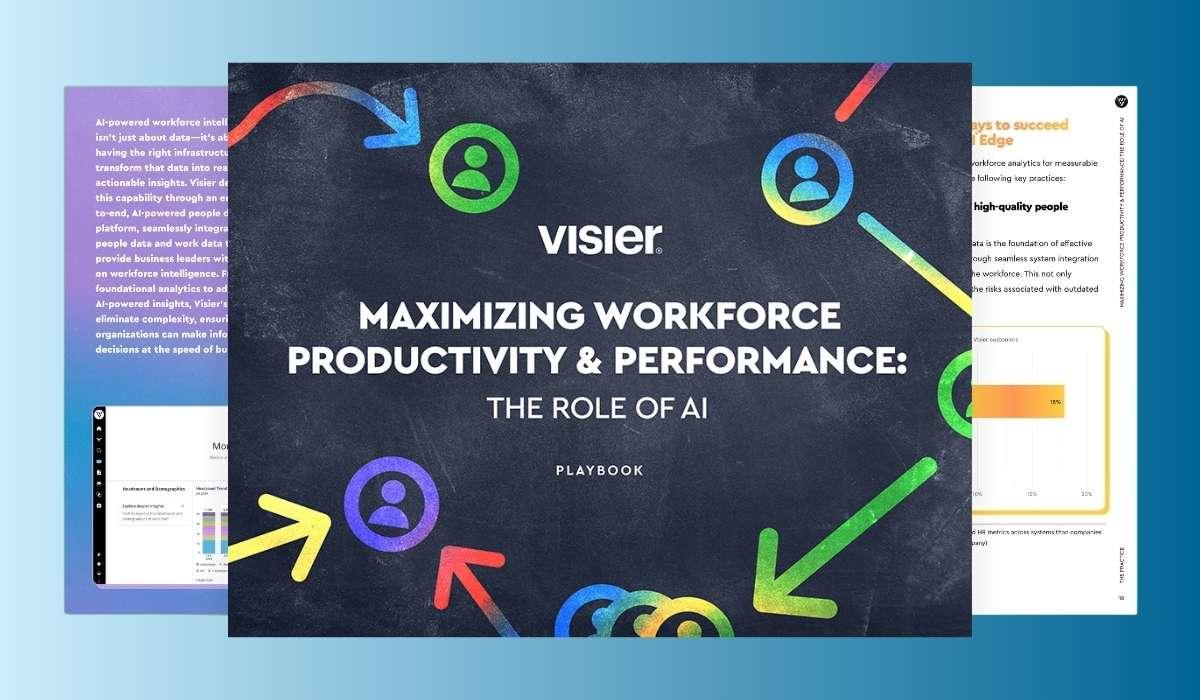
Business leaders need a smarter, data-driven approach to workforce performance. Get the playbook on how AI-powered workforce intelligence helps organizations enhance productivity, reduce inefficiencies, and unlock measurable business impact.
Visier Research found that business leaders define productivity around five themes: efficiency, goals and objectives, output and results, customer focus, and measurement. Definitions vary meaningfully by function, with revenue leaders emphasizing pipeline and bookings, and technology leaders emphasizing on-time, on-budget delivery.
Inefficient processes and workflows, cited by 65% of business leaders surveyed. This ranked well above measurement challenges (30%) and data accuracy issues (20%).
Based on our research, output and efficiency are the two KPIs business leaders rank highest when evaluating workforce productivity.
There's no single formula. Business leaders in our survey most often measured productivity through output and efficiency metrics such as tasks completed, work output versus hours worked, and utilization rate, paired with revenue metrics like revenue per employee. The right mix depends on the function: sales leaders lean on pipeline and conversion, while technology leaders lean on delivery timelines and cycle time.
Productivity measures output relative to time and resources. Engagement measures how invested employees feel in their work. The two are related but distinct: our survey found employee engagement ranked lower as an obstacle to productivity than process inefficiency did, suggesting that broken workflows can still hold back a motivated workforce.
This research is part of the Visier Research program, which studies of-the-moment workforce and organizational trends using data and executive insight. Explore more findings on the Visier Research blog or see how Visier helps organizations increase workforce productivity.