
VISIER WORKFORCE AI FOR PEOPLE ANALYTICS
Deliver workforce insights. Before they DM you for spreadsheets.
How to scale PA while execs sidestep the function
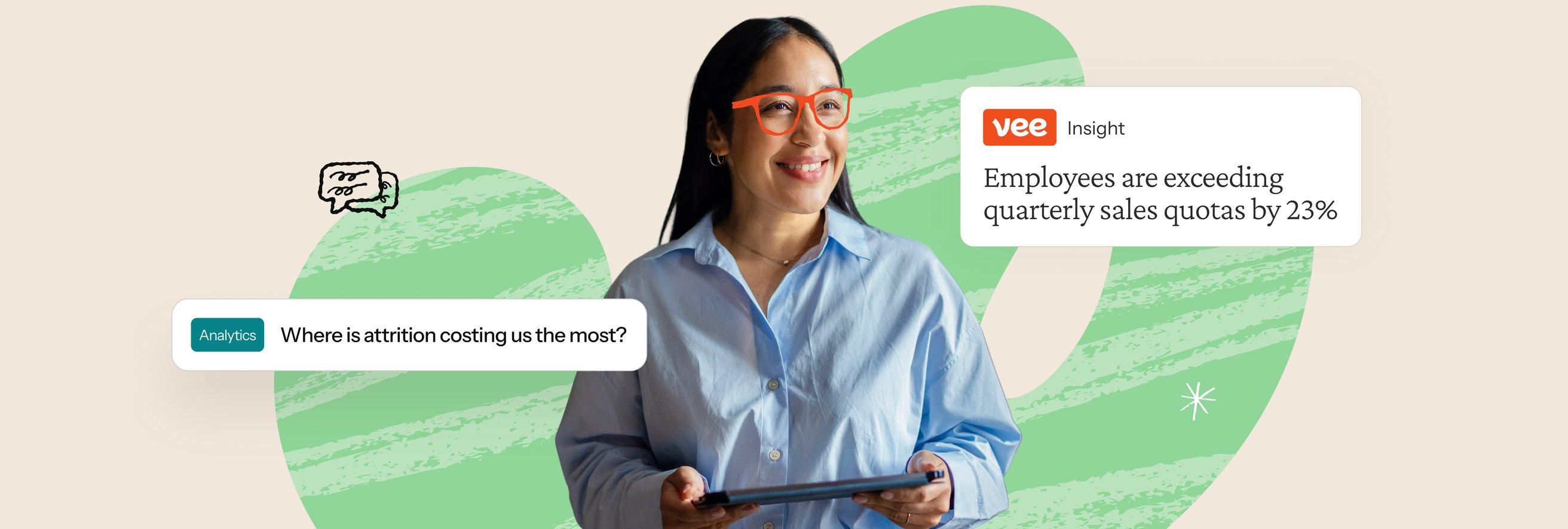
Trusted by 85,000+ complex organizations













The old operating model is broken
Ops takes the hit when HR relies on manual reconciliation
IT IS ALREADY CONSOLIDATING DATA
PA
is at risk of losing control of data to IT, which can strip it of critical workforce context
EXECS EXPECT ANSWERS NOW (OR TURN TO GENAI INSTEAD)
60%
but just 5% report being ahead of the curve
“OUTDATED” FUNCTIONS ARE ON THE CHOPPING BLOCK
40%
of orgs have already cut “outdated” roles, making now the time for PA to prove impact
“Leaders rank improving people analytics as a top priority for ROI, yet only 27% of execs believe their HR team effectively advises them. People Analytics deserves more credit, and more credibility.”


AI killed static data. It could kill PA too.
Right now, 70-80% of PA capacity is gobbled up sifting for data stories through:
Fragmented data across HCM, payroll, and talent systems
Manual insights from tickets and ad-hoc requests
BI tools and spreadsheets that create more work
This leaves PA stranded in Reactionary Land. While they should be delivering insights that move the needle.

People Analytics of the future doesn’t fetch point-in-time data
Data of the future is continuously updating. Enabling PA to:
Own workforce intelligence without having to chase down every ad hoc request
Own defensible insights by identifying drivers of attrition and predicting risk
Own program impact over time in language that translates up the chain
VISIER WORKFORCE INTELLIGENCE PLATFORM
Influence what happens next
Built to scale complex insights. Powered by 16 years of workforce data engineering.
 Understand
Unify all people data
Bring data scattered across systems into one trusted source. Keeping it accurate, governed and AI-ready.
 Plan
Model for what’s to come
Influence smarter forecasting and workforce decisions. With defensible insights that align with business goals.
 Activate
Prove business impact
Monitor program impact and quantify results in a language shared by execs and the Board.
- 2,000+
prebuilt metrics
- 20+
prebuilt connectors
- 11
domains represented
- 250M+
HR benchmark points
- 2B+
comp benchmark points
- 85K+
orgs contributing
THE LAYER ORGS NEED THAT IT SOLUTIONS DON’T INCLUDE
Guesses gamble with data, context leverages it
Decisions with auditable reasoning
Humans and AI understand impact, generate scenarios and roll out at scale

GenAI tools and agents
Follows rules set by the Context Engine on continuously-updating input

Proprietary Context Engine
Unifies your people data with workforce-specific rules, definitions and guardrails
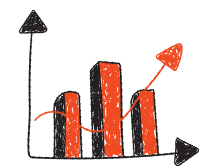
Workforce data
All your people data, macro insights and HR science as raw input
EVERY PRIORITY. ONE PLATFORM
Fire off insights across org priorities
Workforce Investment
Own the numbers
Connect workforce moves to financial outcomes.
With a real-time look at timekeeping, scheduling and HR systems.
Workforce Redesign
Own the restructure
Produce forecast- and scenario insights Finance and HR leaders need for better decisions.
Tap into clean, consistent, time-aware data across headcount, roles, and organizational hierarchies.
Workforce Alignment
Close AI capability gaps
Predict and track program impact without the usual blindspots.
Get better visibility into career paths, tenure, performance and movement patterns.
Employee Turnover
Prevent regrettable attrition
Identify drivers of attrition, predict risk and measure how well retention strategy worked.
With a unified view of recruiting, onboarding, engagement and exit data.
Hiring
Hire smarter, deliver value faster
Provide defensible insights, metrics and measurable progress that orgs need for better, compliant hiring.
Harmonize data across pay, performance, demographics and job structure. Tie it to external metrics.
Leadership
Develop managers, prove it worked
Quantify skill gaps, translate learning and sentiment into actionable insight and measure program impact over time.
Tap into this with unified data from surveys, workforce metrics and behavioural signals.
CUSTOM DEMONSTRATION. 30 MINUTES OR LESS.
See how PA scales with AI
Bring us the talent problem you’re being measured on. We’ll show you how Visier connects it to a business outcome you can prove.
Book a DemoContact SalesPeople Analytics 101
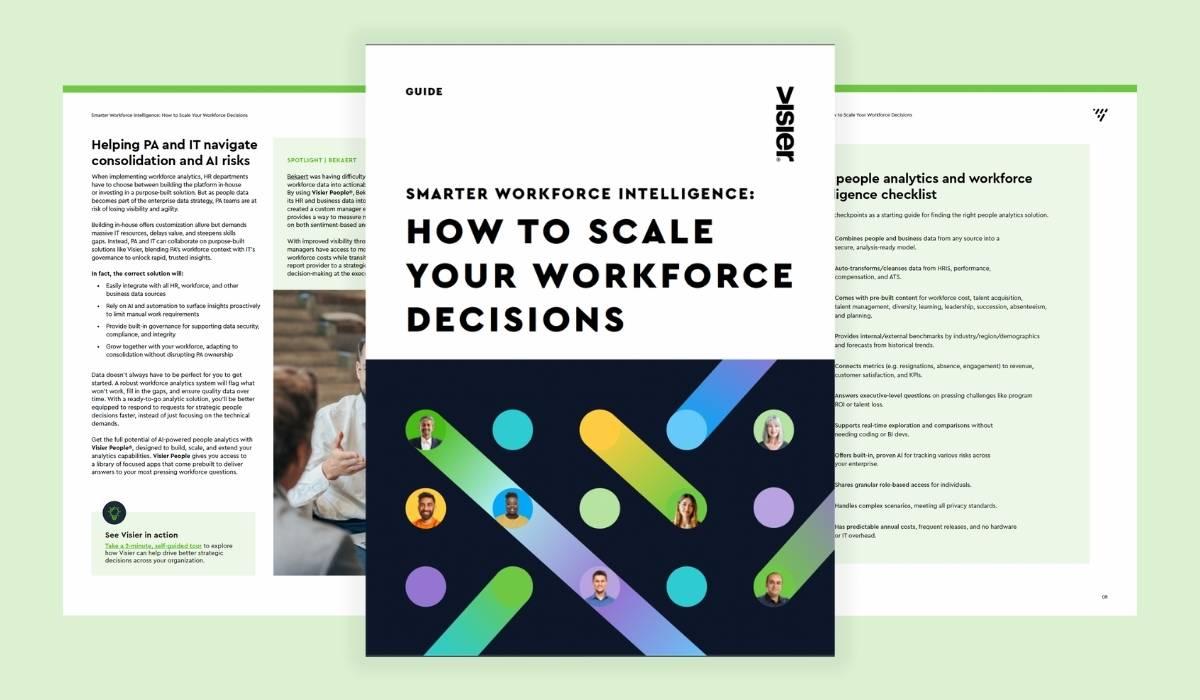
Smarter Workforce Intelligence: How To Scale Your People Decisions
Practical steps to accelerate your people analytics and workforce intelligence journey
Governed, secure, makes IT happy




Questions PA leaders ask
Why not just build this internally?
Internal builds often recreate the same problems: complex data modeling, heavy maintenance, and slow insight delivery. They also tie People Analytics to IT roadmaps, slowing delivery further and limiting the ability to scale to AI or business needs.
Isn't our HCM and BI reporting good enough?
HCM and BI tools expose data but don't resolve fragmentation, enforce consistent definitions, or connect insights to business outcomes. Access widens; trust and alignment still depend on a governed model underneath.
Why add another tool when we already have too many?
The real question is whether to keep running a disconnected stack that can't scale. Visier extends your existing tools and platforms.
What if we're just not ready yet?
Waiting doesn't fix data quality issues, capacity constraints, or governance gaps. Most People Analytics teams are already at capacity, and without structural change, readiness never improves while executive expectations keep rising
What if our data isn't clean enough?
No organization has perfectly clean workforce data. Without a governed model, data issues become more visible and damaging. A structured platform improves consistency and creates a path to ongoing data quality improvement.
What about AI and data governance risks?
Ungoverned AI usage is already happening across most businesses. The real choice is whether it gets used safely, with trusted, governed data, or unsafely, without it.
How do we explain how the outputs are generated?
This is fundamentally a credibility issue. A structured workforce intelligence foundation makes methodology visible, definitions auditable, and outputs explainable, which protects PA's credibility with executives.
Shouldn't IT own this?
IT should own the infrastructure. People Analytics needs to own the workforce data model itself, because when it doesn't, definitions drift, context gets lost, and insights disconnect from HR strategy.
Don't we need to prove ROI first?
The current fragmented model is what makes ROI hard to prove in the first place, since it limits scale and consistency. Without foundational change, People Analytics stays a cost center. Foundational change is what turns it into a strategic driver.
Isn't this a big change to take on?
The current operating model is already under strain. Sticking with it carries more risk than evolving it.