
Measuring Manager Effectiveness
Research reveals how 20+ organizations leverage data to define, measure, and enhance leadership success.
ReportMay 15, 2024
Key takeaways
Visier researchers interviewed 22 HR representatives from global organizations in the United States, Europe, and the Asia Pacific region.
The four phases of enabling manager effectiveness are: 1. Define “good” management; 2. Identify potential; 3. Measure, and measure again; 4. Support managers.
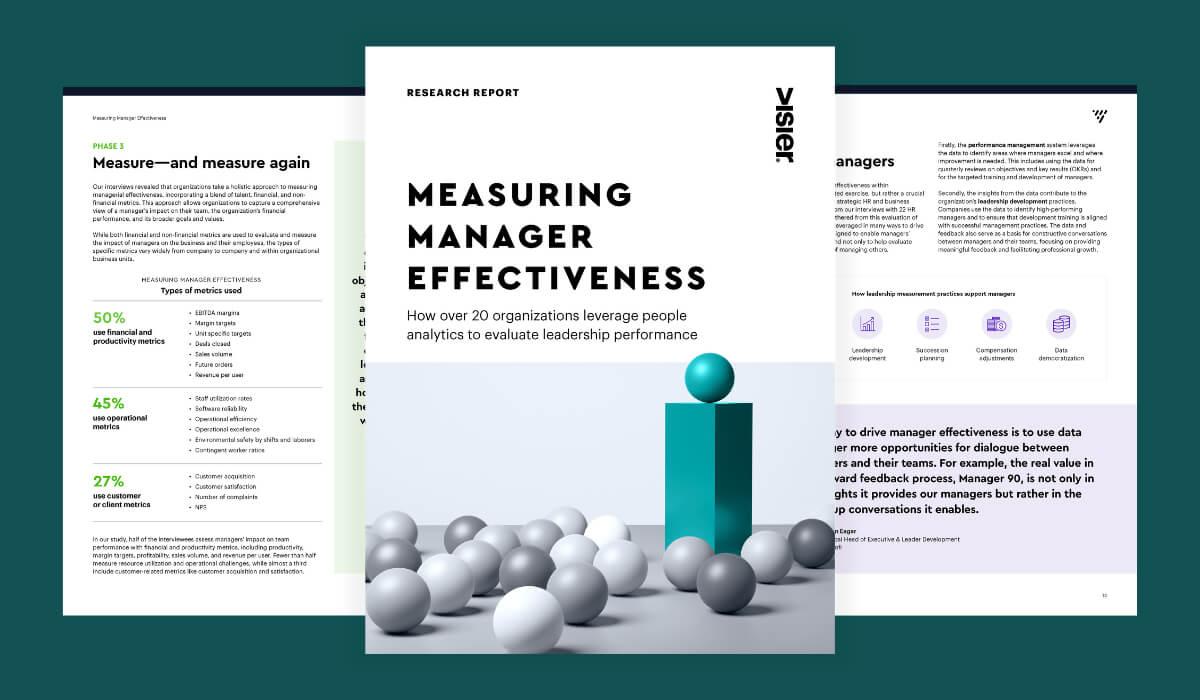
In Visier's 2024 study, half of the interviewees assess managers' impact on team performance with financial and productivity metrics, including productivity, margin targets, profitability, sales volume, and revenue per user.
According to Visier's 2024 study, the majority of study participants (65%) shared that metrics relating to employee engagement levels within the manager's department, the overall culture score, and employee engagement survey data focusing on manager quality, team happiness, and the environment managers create, are increasingly part of talent reviews and performance assessments of managers.
In Visier's 2024 study, metrics related to employee turnover, primarily the attrition of regrettable leavers, are used by more than half (55%) of study participant organizations to assess a manager's ability to retain top talent and create an environment that encourages employee loyalty.
According to a Visier survey cited in the 2024 report, only 38% of individual contributors are interested in becoming a people manager at their current organization.
Current approaches to leadership and management development seem fundamentally broken, despite a thriving leadership development industry that represents more than a $60 billion annual investment by global firms. Too often, management development programs lack rigorous measurement.
In-depth interviews with 22 HR representatives reveal how leading organizations take a different approach, using a blend of talent, operational, and financial metrics to measure manager effectiveness. The report highlights how sound leadership evaluation practices follow four distinct phases, beginning with the definition of good management and ending with specific actions to drive performance. This method produces a comprehensive view of a manager's impact on employees and organizational goals.
Frequently asked questions
What are the four phases of measuring manager effectiveness?
The report highlights how sound leadership evaluation practices follow four distinct phases, beginning with the definition of good management and ending with specific actions to drive performance.
Define “good” management: Ensure business and people alignment; Be specific about managerial success
Identify potential: Review existing data and information; Separate performance and leadership potential
Measure, and measure again: Identify the right metrics; Enable access to people data
Support managers: Onboard managers to their next role; Clarify expectations with managers
What metrics do organizations use to measure manager effectiveness?
In-depth interviews with 22 HR representatives reveal how leading organizations take a different approach, using a blend of talent, operational, and financial metrics to measure manager effectiveness.
In Visier's 2024 study, half of the interviewees assess managers' impact on team performance with financial and productivity metrics, including productivity, margin targets, profitability, sales volume, and revenue per user.
According to Visier's 2024 study, the majority of study participants (65%) shared that metrics relating to employee engagement levels within the manager's department, the overall culture score, and employee engagement survey data focusing on manager quality, team happiness, and the environment managers create, are increasingly part of talent reviews and performance assessments of managers.
In Visier's 2024 study, metrics related to employee turnover, primarily the attrition of regrettable leavers, are used by more than half (55%) of study participant organizations to assess a manager's ability to retain top talent and create an environment that encourages employee loyalty.
Why do organizations measure manager effectiveness?
By measuring manager effectiveness, HR and business leaders can gain an understanding of the impact their managers have on the workforce, and what may be needed to develop and empower them to drive superior team performance and organizational success. Organizations measure manager effectiveness for several reasons:
They want better visibility. Tracking manager effectiveness metrics provides HR leaders with better visibility into the performance and effectiveness of their organization's managers.
They want to connect the dots. Analyzing the connections between performance metrics, manager effectiveness, and team outcomes enables HR to identify the management practices that drive the best results.
They want to understand how managers are delivering business impact. Applying people analytics to assess the business impact of managers allows HR to identify not just the poor performers, but also the exceptional managers who may be exceeding expectations.
How do organizations use manager effectiveness data?
The evaluation of manager effectiveness within organizations is not an isolated exercise, but rather a crucial input that feeds into various strategic HR and business processes.
Firstly, the performance management system leverages the data to identify areas where managers excel and where improvement is needed.
Secondly, the insights from the data contribute to the organization's leadership development practices. Companies use the data to identify high-performing managers and to ensure that development training is aligned with successful management practices.
It's all in the new report—download to learn:
The four phases of measuring manager effectiveness
The benchmarks organizations use to assess managers beyond financial metrics
How access to people analytics is key for evaluating performance