
A Guide To Organizational Design
Organizational design shapes the way an organization is structured and run. It impacts employee well-being, engagement, and productivity. Read on to learn more.

Visier analyzed 7.7 million employee records across more than 170 enterprise-sized organizations. We found that 77% made a significant structural change to their teams over the past five years.
Growth, reductions, mergers, AI adoption…the trigger is different from one company to the next, but the underlying reason is the same: the org chart from 18 months ago no longer describes how the business functions today. That’s the challenge organizational design helps solve.
This guide covers what organizational design is, who benefits from it, and the principles and metrics that help you structure your org properly. You’ll also get insights pulled from Visier research, as well as directly from interviews with HR and org design leaders on how real companies are restructuring in the AI era.
What is organizational design?
Organizational design is the process of aligning your company’s hierarchy, job functions, workflows, and chain of command with its broader strategic goals. It defines how work gets done across the company and who's accountable for each component.
The main aspects of org design are:
Structure and hierarchy: how the org is grouped and how many management layers sit between the CEO and the frontline
Roles and responsibilities: what each position owns and how that scope is defined by level rather than by person
Reporting lines: who each person reports to, including dual or dotted-line relationships
Decision-making authority: which decisions are made at which level and what escalates
Workflows and processes: how work and information move between teams and where the handoffs are
Team size and spans of control: how many people each manager oversees
Skills composition: The mix of levels, skills, and worker types on a team, including the increasing mix of human and AI distribution of work
Company culture: the norms and behaviors that determine how the structure actually operates day to day
A few decades ago, organizations typically had a hierarchical structure. They had a strict division of labor, a clear chain of command, and a centralized decision-making process. Over time, things shifted.
According to research published in 2025 looking at the spans and layers of 2,600 US public firms (opens in a new tab), “Firms have on average ten hierarchical layers and a pyramidal organizational structure.”
Clearly, hierarchy still exists—but today, organizational design is more complex. Over the years, there’s been more emphasis on employee satisfaction and well-being, while authority has become more distributed; increasingly, the decision-making process no longer involves only execs.
And now, AI is driving lightning-speed workforce transformation. As that same research discovered, “Companies flatten their hierarchies following the adoption of AI technologies." With AI injected into more and more areas of the workforce, how will it continue to affect the typical organizational structure?
What is the goal of organizational design?
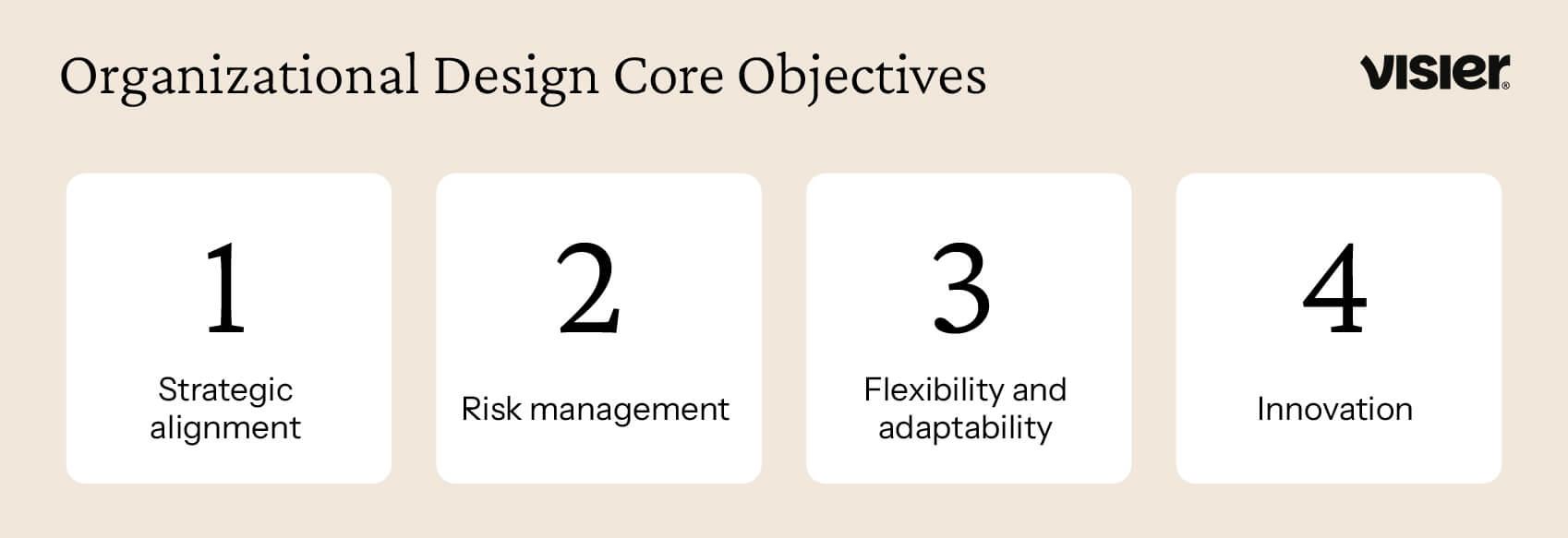
Organizational design exists to ensure a company's structure actually serves its strategy. When the two are out of sync, the business feels it everywhere. Accountability is unclear, so teams make slow decisions and end up duplicating work.
Andrea Derler, Ph.D., Visier's Principal of Research and Value, interviewed HR and org design leaders at various companies to learn what it means for their business as a whole, as well as for their employees.
As one global leader explained, organizational design “is not a one-off activity, but a strategic way of mapping the organization to the business reality."
Why org design matters for the business
Businesses care about org design because structure directly affects cost, speed, and clarity. The life sciences organization we spoke with said leaders treat it as a "constant and non-negotiable business activity" that gets triggered from both directions:
Top-down to reflect changes in corporate strategy
Bottom-up when operational problems surface on their own
And it seldom serves just one goal at a time. The same redesign has to simultaneously balance cost control, career pathways, organizational clarity, and financial sustainability.
That tension between effectiveness and cost control doesn't resolve itself. In Visier’s research, one HR leader described it as a persistent, ongoing task, not a problem you solve once and move past. Another indicated that org design had become the "unifying starting point" for broader planning conversations, precisely because it forced all those competing priorities into a single view.
Why org design matters for employees
Organization design isn’t an abstract concept to the people living within the structure. They’re the ones most affected by the (re)design decisions. The organization design helps determine whether your people can see a path forward in their career and whether the system treats them fairly along the way.
For example:
At the large healthcare organization interviewed by Visier for the Visier Insights™ Report: Designing Impactful Teams, leaders explicitly track job-level distribution and the salary differentials between managers and non-managers, because those gaps shape how fair the structure feels.
At another global company, career pathway development is a stated goal of the org design process itself, with promotional guidelines and talent assessment tied directly back to it.
Structure also shapes opportunity in less-obvious ways. The experience shared by the interviewed healthcare organization shows that decentralizing a function can actually narrow career paths for individual contributors compared with keeping them in a centralized “Center of Excellence” where advancement routes are clearer.
What does org design help companies achieve?
Business goals | People strategy goals |
|---|---|
Eliminating redundant or overlapping roles | Clarifying who owns what, so employees aren't guessing who to go to |
Streamlining task handoffs between teams | Defining realistic spans of control so managers aren't stretched too thin |
Reducing decision-making bottlenecks caused by unclear authority | Creating visible paths for promotion and advancement |
Right-sizing headcount and cost against strategic priorities | Setting clear escalation paths so problems don't stall between teams |
Cutting duplicate work across teams doing the same job differently | Making onboarding faster because roles are well-scoped |
Identifying where layers or bureaucracy are slowing execution | Reducing burnout from unclear or overloaded responsibilities |
Who benefits from organizational design?
Org design touches nearly every function in the business. Different teams draw something different from it, from HR leaders using it to justify structural decisions at the board level to individual employees experiencing it through a clear chain of command.
HR leadership
A well-structured org gives CHROs and HR leaders across global, regional, and business-unit levels a direct line between headcount decisions and business strategy. So when the board asks why headcount is where it is, or why a function is organized a certain way, org design data gives them a direct answer tied to costs and outcomes they want to achieve.
HRBPs and field HR
Effective org design means HRBPs aren't the ones absorbing the fallout when reporting lines are ambiguous or a single manager is stretched across too many people. Defined roles and reasonable spans mean fewer escalations land on their desk in the first place.
Specialized HR functions
When roles and grades are clearly and consistently defined across the company, human capital planning and benefits teams aren't each working from their own interpretation of what a given role or level is. This makes processes like hiring and benefits eligibility a lot less complicated.
Business leaders
Department heads and the Executive Committee are the ones who run your org structure day to day, which makes them accountable for how it’s implemented. Involving them in org design decisions prevents them from inheriting structural limitations that create friction between teams and stall execution.
Finance
Org design is what converts labor spend into financial performance; it bridges the gap between HR's focus on talent and Finance’s focus on budget. A deliberately designed structure keeps the labor costs aligned with financial forecasts (so the company isn't overhiring) and ensures every dollar you spend on headcount improves productivity.
The business broadly
The high-level outcome of all this is that you get more results for the same (or less) labor spend because people work together more efficiently, both within and across teams. This also makes for a more agile company; that foundation means you can make workforce changes without disruption or rebuilding from scratch.
What are the 5 principles of organizational design?
The Visier Strategic Advisory team, frames the org design discipline around four capabilities. Those capabilities describe how you run org design as an ongoing practice:
Visibility into how the structure performs against business goals
Connection between structural decisions and business outcomes
Collaboration that pulls input from across the org rather than just from the top
Adaptability as conditions change
Then, with these capabilities at play, they build an organizational structure with five specific traits:
Alignment to ensure org structure is linked directly to business goals.
Scalability to ensure the design accommodates future growth.
Flexibility to continuously adapt to market volatility and change.
Clarity for the business and for employees, where roles, responsibilities, and decision rights are clearly defined.
Accountability to ensure individuals are clearly responsible for specific outcomes.
1. Alignment: Every structural element links directly to business goals.
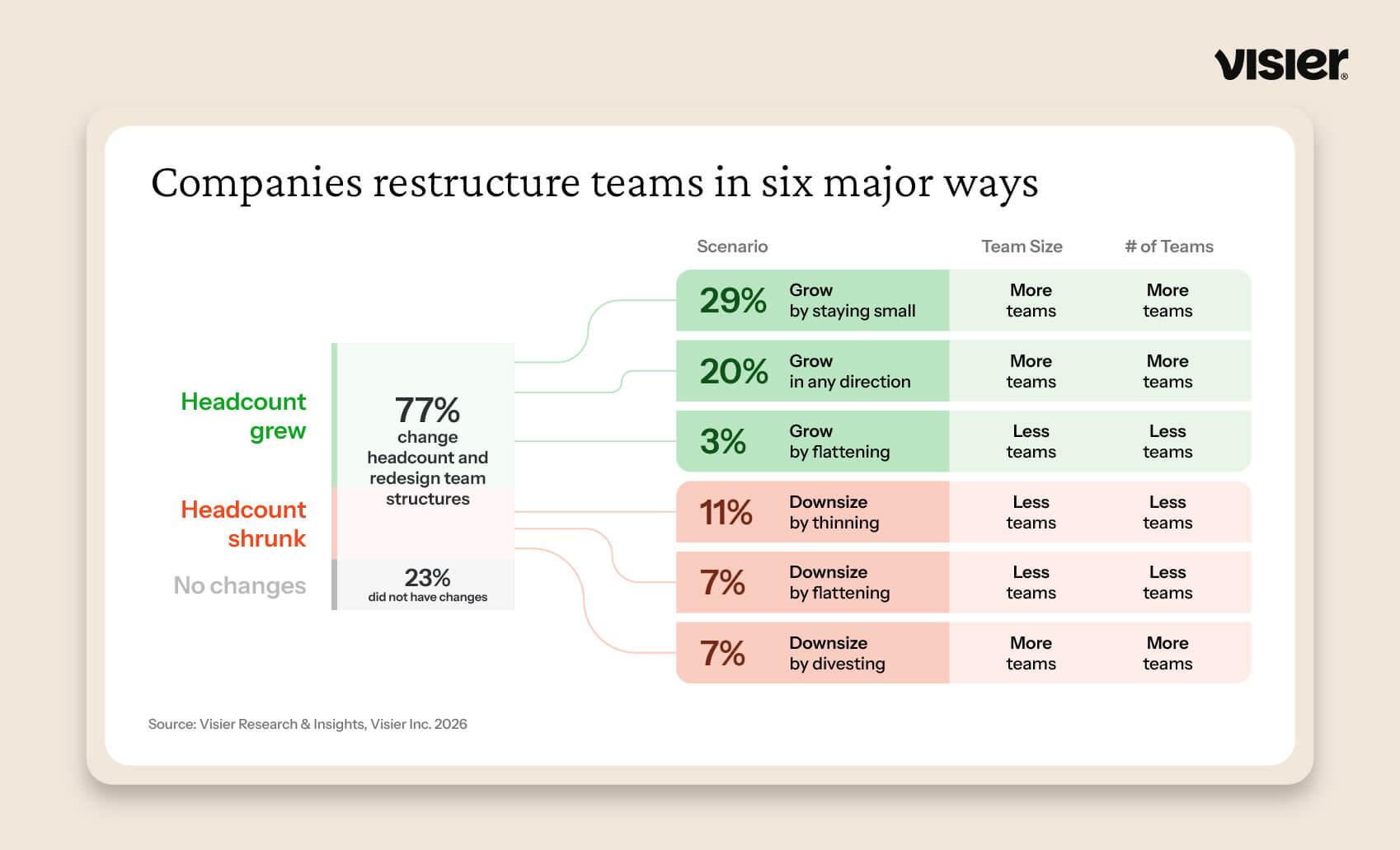
Visier's DNA of Organization Design report found that among companies growing their headcount, 56% chose to add more teams while keeping each one small, prioritizing agility over consolidation rather than defaulting to fewer and bigger teams.
That's the right move when your strategic priorities are speed and innovation. But when you’re shifting toward scale and operational efficiency, and your culture depends on standardized processes with central oversight? Not so much.
As Derler found in her interviews with HR leaders, one global consumer packaged goods manufacturer designs R&D, Sales, and Factory and Supply Chain as distinct domains specifically to avoid falling into default mode during org design. Each is aligned with what that part of the business actually needs.
R&D can run small and agile to protect speed to innovation while manufacturing consolidates around standardized, repeatable processes. Same company, two different answers, because strategic and operational demands differ from one area to the next.
Org design snapshot: Aligning org structure to strategy at 50,000 employees
A financial services organization with 50,000 employees had outgrown the spreadsheets it used to plan its full-time, remote, and gig workforce. This type of planning sat with Finance and was cut off from broader business goals.
After moving to Visier, this organization replaced annual planning cycles with continuous planning tied to business strategy. More than 100 VPs, directors, and managers now plan headcount together from one source of truth. Read the full story →
2. Scalability: The design accommodates future growth and operational expansion.
A structure that works with 500 people won't automatically work at 5,000. The span of control naturally narrows near the top.
Among Visier’s customers, who have anything from 5,000 to over 100,000 employees, we see that bottom-tier managers overseeing more standardized work are able to sustain wider spans, while top-tier leaders manage higher-stakes, less repeatable decisions and need more time per report, which is why their spans narrow.
For example, a CEO or VP rarely has more than five to eight direct reports because their responsibilities require deep strategic alignment. But a front-line manager might successfully manage 15 to 20 people.
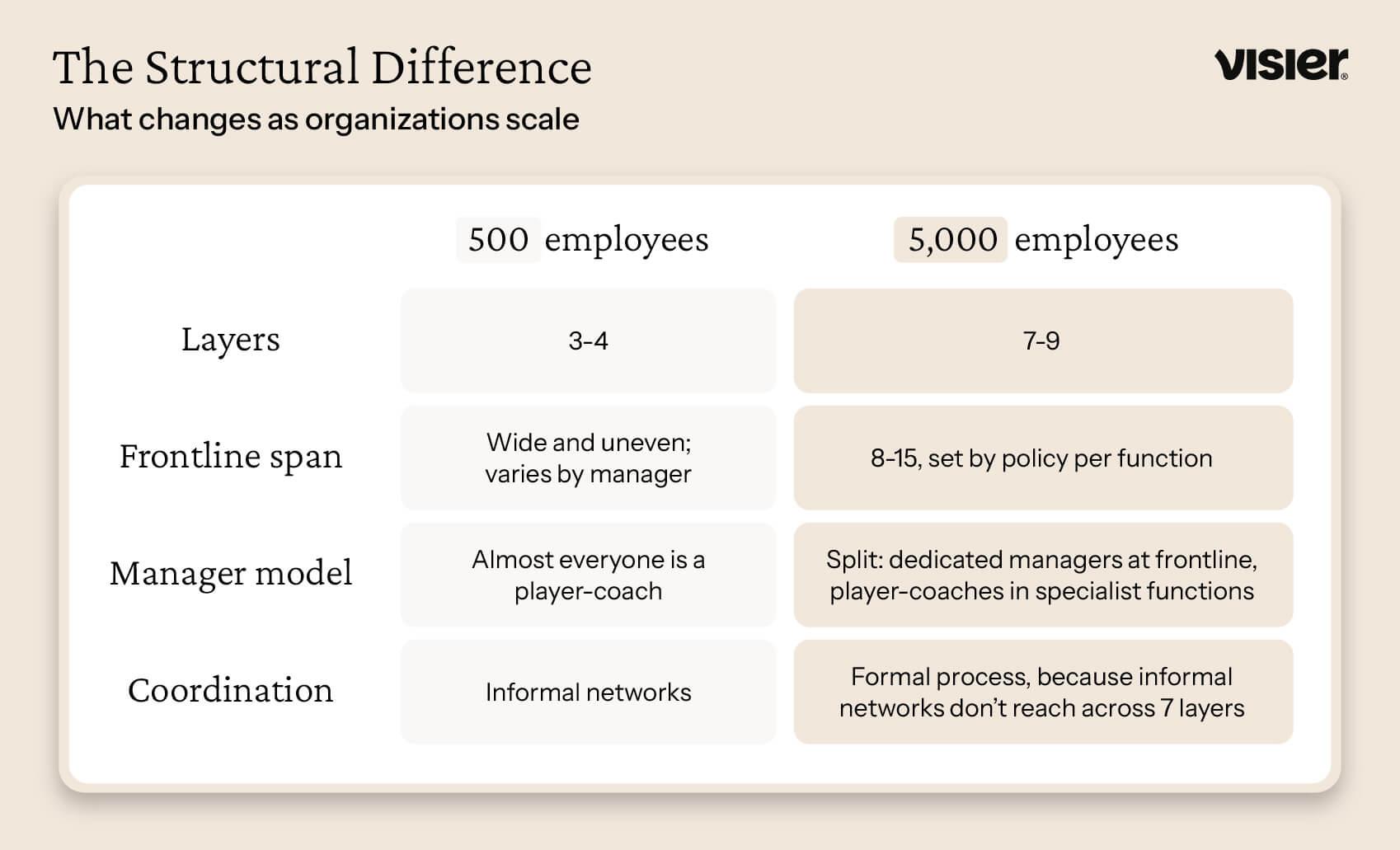
That range reflects deliberate choices about where oversight matters most. Span should scale with how much judgment the work requires, rather than following a flat companywide target.
Let's look at the player-coach model, where managers split time between supervision and problem-solving. In this scenario, orgs need to structure around tighter spans to protect that bandwidth. Managers with purely supervisory roles can handle more direct reports.
Designing for scale means deciding which model you're running before you grow into a span that no longer fits.
3. Flexibility: The structure can continuously adapt to market volatility and change.
A structure that’s solid on paper can still fall apart within a quarter. That's what happened to a global financial intelligence company with more than 40,000 employees when a major acquisition landed on the table.
Up to that point, the company conducted structural evaluations periodically, and worse, it was a manual process. Modeling the financial impact of relocating teams or adjusting reporting layers required exporting data into spreadsheets and building PowerPoint decks from scratch. The process depended on consultants, making it slow and expensive.
After deploying Visier’s Org Design tool, the company could model span of control, layering, and cost trade-offs in a single environment. They could then make evidence-based decisions based on the projected costs and each design’s workforce impact.
This is a common pattern we see in many of today’s enterprises: they wait for something to force the issue before they give org design the attention it deserves. By then it’s too late; your approach is reactive. Course corrections have real costs to the business and the humans running it.
4. Clarity: Roles, responsibilities, and decision rights are clearly defined.
Role definition work has a fixed cost per role, whether you're defining a VP's mandate or an entry-level analyst's. Naturally, companies pour effort into the roles that feel most high-stakes: executive and senior leadership positions, because a VP’s true “place” in the organization feels expensive to get wrong.
But there are typically only a handful of those roles. Further down the org chart, there are thousands of other individual contributors. So the aggregate cost of ambiguity at the bottom, multiplied across the workforce, almost always dwarfs the cost of ambiguity at the top, even though it receives a fraction of the attention.
You can't fix that by writing better individual role descriptions for thousands of people. The fix is architectural: build a job-leveling framework, standardized by job family, that defines decision rights and scope by level rather than by person.
This also plays into the (re)newed focus on how skills are informing role design within the organization. Especially as AI agents become a part of the workflow, across a larger number of roles, understanding the human-agent breakdown of skills and how they fit together is paramount.
A leveling guide that clearly defines what a "Level 3 Analyst" owns versus what escalates, applied consistently across every team using that title, does more to create clarity at scale than any number of individually written role docs.
Senior, low-volume roles can stay bespoke because there are few of them, and the stakes justify hand-crafting each one. But for org design to work, your high-volume roles need the opposite approach.
5. Accountability: Individuals are clearly responsible for specific outcomes.
There are two parts to accountability in org design: accountability for the design itself and accountability within it. So what happens when problems arise at the execution layer, and the people who own the outcome aren't the same people who shaped the decision?
Our interviews surfaced a specific disconnect between the two: HR builds the structure, but business leaders are the ones who have to run it day to day.
HR ends up taking the blame for a structure it was told to build, even when that structure doesn't work in practice, while the business leader ultimately responsible for the outcome is set up to fail within a structure they didn't choose.
The fix is to make the business leader who inherits a structure the same one who signed off on it in the first place. Then route the design through an Executive Committee review before it rolls out, so the people accountable for the outcome are the same people responsible for the decision.
3 types of metrics critical for org design
Companies look at three different kinds of metrics to design and evaluate the performance of their org design: structural metrics, workforce composition metrics, and financial/performance metrics.
Every redesign is a set of trade-offs, and each one carries both a benefit and a risk. Tracking these metrics is what turns that trade-off from a guess into a decision you can defend.
Below, you’ll find what each is for and the most critical ones to track.
Structural metrics
Structural metrics show you whether the shape of the org itself (its spans, layers, and job levels) still matches how the business is meant to run.
The most important ones to look at are:
Spans and layers: How many people each manager oversees and how many management layers sit between the CEO and the frontline
Org shape and structural patterns: Whether the org is pyramid-shaped, flat, or something in between, and whether that shape is intentional
Grade mix: The distribution of job levels across the workforce
Percentage of senior leadership: How much of the headcount sits in executive roles relative to everyone else
Manager ratios: How many managers there are relative to individual contributors, and whether that ratio holds across functions
What’s more, this standard set of baseline metrics isn’t one-size-fits-all. The healthcare organization interviewed for the Visier Insights™ Report uses Visier to track a "director-plus ratio" and a "frontline manager ratio"—custom cuts of a standard metric that catch undersized teams and managers missing direct reports before either turns into accountability problems elsewhere.
Your structural problems are specific to your business, so the metrics that catch them early must be just as specific.
Workforce composition metrics
Workforce composition metrics tell you who's actually doing the work, and whether that mix still fits the structure it's built on.
As a minimum, it's recommended to track:
FTE-to-contractor ratio: How much of the workforce is full-time versus contract, affecting both cost and continuity?
AI agents and bots, mix of bots and employees by team: How much of a team's quantifiable output now comes from automation rather than human workers?
Revenue-generating vs. non-revenue-generating teams: How much of the org sits in functions that directly drive revenue versus support it?
Number of positions with direct reports: How many roles are actually accountable for managing others versus holding the title without it?
Location breakdowns and time zone overlaps: Where the workforce actually sits, and how much of the day teams can work together in real time
If you noticed, metrics on AI agents and bots made the list because they are already leading to workforce transformation—even if you haven’t started tracking it yet.
So, what happens when AI agents begin handling a third of a team's support tickets? The obvious question is whether the team still needs its current headcount or whether customer service needs a total redesign around the tickets that still require human support.
How exactly is AI impacting the workforce? We recently analyzed 3.6 million employee records across 155+ enterprises in Hidden in the Headcount: The State of Workforce Transformation During the AI Reckoning to find out.
What we discovered in the hiring trend data is that there are dramatic shifts within specific job domains. It's reshaping the workforce, but not always in the ways we predicted.
Financial and performance metrics
Financial and performance metrics connect the org chart and structure back to costs and outcomes. They help measure whether a design decision is paying off and, hopefully, help pinpoint where your current design is falling short.
The specific metrics you’ll want to monitor are:
Revenue per head, cost per function, and savings from org design: Is structural change moving the numbers it was meant to?
Manager turnover rate, paired with engagement and attrition: Is instability in management dragging down the people underneath it?
HR-specific ratios, like HRBPs per manager: Is HR support scaled to match the structure it's serving?
NPS and Credo survey results: How do people within the structure actually experience it?
Loaded cost: What’s the “all-in” price of labor, including base pay, benefits, payroll taxes, bonuses, and paid absences?
When to conduct organizational design
Plenty of internal and external factors and changes will force you to look at your organizational design with a critical eye. Which is why this org design question is often answered with a standard list of triggers:
A merger, acquisition, or divestiture
A shift in business or people strategy
New technology or automation changing how work gets done
Misalignment between your current design and current strategy
New regulations that change how you handle data or people, such as the GDPR (opens in a new tab) or the CCPA (opens in a new tab)
Undeniably, moments like this will force the question. But treating them as your only cue to reassess organizational design when business is now happening at the speed of AI increasingly puts your business at risk.
Our research proves this: 77% of enterprises made a significant structural change over the past five years.
At that rate, "when something happens" isn’t a once-in-a-decade event; it's becoming a permanent state of existence. The honest answer to when to conduct organizational design is simple: continuously.
When the org’s processes, people, and environment exist in a constant state of change, organizational design must follow suit to operate as an always-on practice. A design revisited only at inflection points is one that spends most of its life out of date.
That's the shift from org design as a project to workforce transformation as a practice. It takes three things:
A live view of structural health: live spans, layers, and micro-teams monitored continuously, not assembled for a review
Design principles that hold: documented rules that flag violations as structures drift, rather than tribal knowledge that erodes
Shared ownership: business leaders sharing the responsibility of the design, not just living on the receiving end
This is the work Visier Workforce AI was built for. Our customers monitor structural health as an ongoing signal and model changes against it before committing, which means the trigger arrives to a structure that's already current—and the reorg becomes an adjustment instead of a rescue.
6 Common organizational design structures
That brings us to our next question: how do organizations structure themselves in practice?
Broadly speaking, there are six main structural models, but most of today’s orgs combine aspects of more than one based on the individual needs of their company or a specific department.
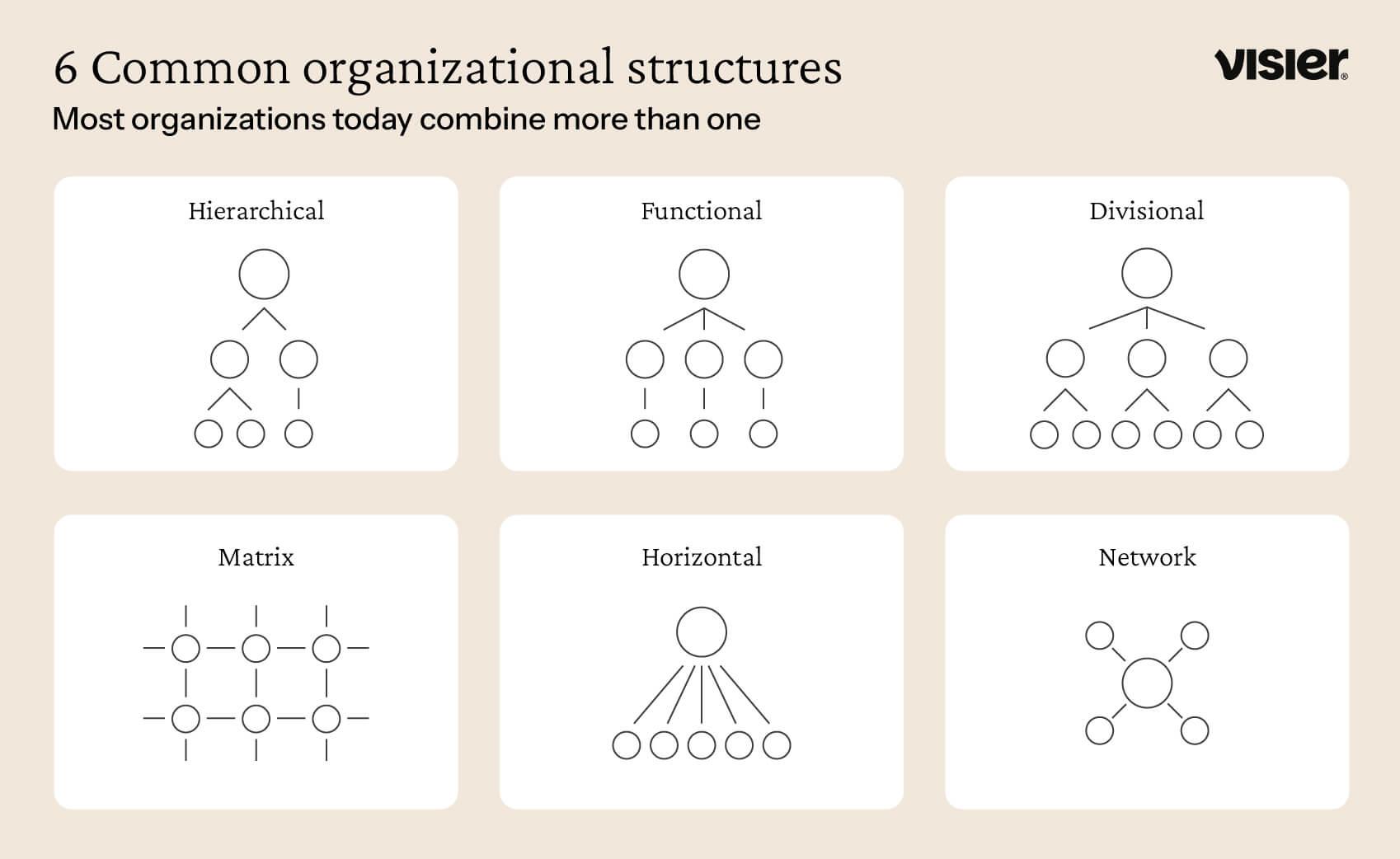
To show how that plays out within a real enterprise, we'll also use org design elements from a global healthcare manufacturer featured in Visier's research, operating across more than 60 countries.
1. Hierarchical
A hierarchical structure organizes the company into stacked layers of authority, with each employee reporting to a single manager one level above. Headcount widens at each layer down, creating the pyramid shape.
This is the baseline most large organizations still run: the vast majority of workers sit at the bottom, with headcount declining sharply toward the top. Still, within this common design, many other models may follow.
The next four models describe how those layers are grouped. Network is the only one that steps outside the hierarchy entirely.
2. Functional
A functional structure groups employees by a specialized skill or duty. For example, a company organizing into Marketing, Finance, and Engineering departments, each with its own chain of command.
Most traditional companies use this model because grouping by expertise maximizes specialized efficiency. That’s why the healthcare manufacturer splits departments like R&D, Sales, and Factory and Supply Chain into distinct domains.
Even companies running divisional or matrix models at the top level still organize functionally within each division or subsidiary.
3. Divisional
A divisional structure groups employees by product, service, or geographic market rather than by skill or function. This becomes necessary once you’re operating across multiple separate markets, product lines, customer segments, or subsidiaries. At that scale, a single centralized approach won’t fit them all equally.
The same company splits at the top level into distinct business segments: medical devices, pharmaceuticals, and consumer products. Because those businesses share almost nothing operationally, each runs with high autonomy over day-to-day operations and strategic direction.
4. Matrix
A matrix structure gives employees dual reporting lines: one to a functional manager and another to a product, project, or regional lead, instead of a single chain of command. Large enterprises layer this on top of their divisional structure.
With hundreds of subsidiaries across global markets, employees in this company's segments report to both a functional head, such as one in R&D or marketing, and a product or regional leader at the same time.
That dual reporting is what lets the company share deep functional expertise across its autonomous divisions instead of rebuilding it within each one.
5. Horizontal
A horizontal structure (also called a “flat” structure) removes layers of middle management to speed up cross-functional collaboration and communication. It's the structure most often associated with agile startups, where a small team and a short distance between individual contributors and leadership let decisions move fast without routing through several layers of approval first.
Yet it's also the structure the data pushes back on most strongly. Visier's research found only 10% of organizations actually restructured into fewer, larger teams, with 3% doing so while growing and 7% while reducing headcount. That runs counter to a popular narrative that treats flattening as the default move companies are making right now.
6. Network
A network structure is highly decentralized, with the core organization built around outsourced services or freelance contractors rather than direct headcount. The company focuses on its core strengths and, to maintain agility, outsources the rest to highly specialized third-party networks.
There are a few different ways this could look:
Nike, Zara, and Apple centrally control their marketing and product design, then outsource some or all of the actual production.
Uber and Airbnb orchestrate massive external marketplaces; Uber drivers and Airbnb hosts aren’t “employees” of those companies.
Starbucks and McDonald’s operate global franchise networks, but their central corporate offices dictate recipes and brand standards.
That said, purely networked companies are rare in practice. Nike still organizes product design, R&D, and marketing functionally; its DTC and wholesale channels around the world run divisionally, split by market and channel; its subsidiaries (like Converse) operate independently.
Workforce intelligence guiding org design and outcomes you can prove
Workforce intelligence connects workforce data, such as headcount, costs, spans, layers, skills, and attrition, so leaders can see how a structural change will affect the business before they make it. That helps org design move from a one-time project based on a static org chart to an ongoing practice grounded in current data.
With connected workforce context, org design teams can:
Understand: current spans, layers, cost per function, and which teams fall outside design guidelines.
Plan: model scenarios to compare each option’s effect on cost, attrition risk, and skills coverage.
Activate: involve business leaders in the design process so the people who run the structure help shape it.
Organizational design FAQs
What is organizational design?
Organizational design is a process that shapes how an organization is structured and run, dictating the creation of job roles, reporting structures, and workforce processes. It can also be understood as the execution of a company's strategic plan.
What are the main types of organizational design structures?
The two main categories are traditional hierarchical structures, which include functional and divisional models, and modern organic structures, such as network and flat structures. Modern structures tend to allow for more fluid communication and distributed decision-making.
When should a company undertake organizational design?
Organizational design may be triggered by external or internal changes, such as shifts in business strategy, mergers and acquisitions, new environmental factors like legislation, or when the current structure no longer aligns with the company's goals. But increasingly, it is moving from a reactive response to a continuous practice that happens all year round, responding to the business needs in real time.
What are the core objectives of organizational design?
The core objectives include strategic alignment, risk management, organizational flexibility and adaptability, and fostering innovation through cross-functional collaboration.
What is the Ringelmann Effect and why does it matter for organizational design?
The Ringelmann Effect describes how individual productivity decreases as team size grows. This makes team size an important consideration in organizational design, as larger teams also require more management effort and can reduce overall effectiveness.
How can people analytics improve organizational design?
People analytics tools like those offered by Visier can help identify the ideal span of control and team size by department and leader, enabling evidence-based decisions that align workforce structure with business outcomes.
What ongoing analytics support keeps org design aligned with business strategy?
The four non-negotiable analytics layers you need to keep org design aligned with your overarching business strategy are:
Real-time org structure health metrics: These include spans of control by manager and layer, layer depth from CEO to IC, manager-to-IC ratio, and headcount by function against plan. These make up your early warning system.
Cost-to-structure mapping: Most org design work fails (or doesn’t make it past approval) because nobody can pinpoint what a reorg will cost or where the money will come from. Understanding your compensation cost per layer and per function, tied to the P&L, will fix that.
Strategy-to-capability coverage: For each of your top three to five strategic priorities, make sure everyone’s clear on which teams own delivery, the required headcount, what skills are required, and whether the org currently has any skills gaps.
Flow metrics: Internal mobility rate, regretted attrition by team and manager, time-to-fill by critical role, and promotion velocity are the HR metrics that point you to where your org structure is broken.
What is the difference between org structure and org design?
Design is the full set of choices about how work gets done to deliver the strategy—and structure is only the first. The classic frame here is Galbraith's Star Model, which is still the best mental model anyone's produced: strategy drives five design levers, and structure is just one.
Structure: The overarching framework for task accountability and reporting relationships
Processes: How information and decisions move across the structure
Rewards: Comp and incentives that align employees’ goals with the company’s
People practices: Hiring, development, culture, and capability building
Metrics and governance: What gets measured and who makes decisions
Galbraith's point was that changing structure alone seldom works. You can’t drive workforce transformation if you leave decision rights, incentives, and processes aligned with the old structure. Org design requires a more complete approach.
How do you model the impact of a proposed restructuring before implementation?
Before implementing an org restructure, model three or more scenarios to understand how different changes can ripple across your organization. Then weigh the benefits and drawbacks of each option.
There are four areas we recommend looking at:
Cost delta: Comp, severance, recruiting, and the redundancy you're removing. Include the cost of the transition as well (this is where reorgs tend to go over budget).
Span and layer profile: Model the before/after distribution. Not averages—an average span of seven can hide a dozen managers with two reports.
Attrition risk: Which people are landing under a new manager, losing scope, or getting a title change? Manager change is one of the strongest predictors of voluntary exit. Flag your high performers and critical role-holders in that set specifically.
Capability coverage: Pay attention to whether the new teams have the skills their mandate requires; you don’t want to create a gap you'll spend nine months hiring to fill.
Visier’s Org Design module can handle all of these. It features a collaborative modeling canvas with built-in logic for roles, layers, and spans of control. And you can use it to make a current-state vs. future-state comparison against any metric in your Visier instance.
What workforce data is most useful when evaluating organizational design options?
What workforce data is most useful when evaluating organizational design options?
When evaluating organizational design options, the most valuable workforce data helps you answer three important questions: Can the organization execute its strategy? What will the new design cost, and how efficient will it be? And what organizational risks will the design create or reduce?
Broadly speaking, 12 categories of workforce data play a role in the final decision:
Workforce composition
Role and job architecture
Organizational hierarchy
Span of control
Management structure
Workforce costs
Skills and capabilities
Workload and capacity
Performance data
Talent movement (hiring, promotions, attrition)
Employee engagement and experience
Diversity and demographics
On top of that, the strongest organization design decisions integrate workforce data with operational and business data. For example, they account for your strategic priorities, the future capabilities the business will need (e.g., AI competence or automation capacity), and your projected customer demand and service level requirements.
How do you measure whether an organizational redesign delivered its intended outcomes?
To see whether an organizational redesign delivered on its intended purpose, you have to evaluate it differently across three timeframes:
Structural (3-6 months): Immediately following, you have to verify that the design was implemented as intended. Confirm that spans and layers hit the target, roles were filled, and reporting lines were updated in the HRIS. Also track drift, as teams sometimes revert to old ways of working if they’re accustomed to the previous model.
Behavioral (3-12 months): Once you’ve confirmed you’ve made the change and it stuck, move on to how those behaviors manifest in day-to-day operations. Look at whatever success metrics you set for the reorg. For example, if your goal was to alleviate overloaded managers by reducing spans of control, you’d evaluate manager effectiveness scores in newly formed teams.
Business (6-24 months): Longer term, you’re able to look at broader impacts of the change using metrics such as cost per unit of output, revenue per employee, and time-to-market to prove the case.
Why do most reorganizations fail to deliver their intended outcomes post-org design?
The number-one reason most companies fail to deliver their intended outcomes following an org redesign is that they optimize the org structure in isolation without considering the human-level variables that actually govern behavior. The incentives, informal decision-making, cultural norms, and team-level habits remain untouched.
The fix is to involve team and department managers and HR business partners in the redesign process rather than making it a top-down strategy. Get input from people who run the orgs you’re restructuring so you can learn why changes that sound good in theory may or may not work in practice, and which areas really deserve your attention.
Then, when those team- and department-level leaders are ultimately responsible for enacting that change, you’ve already worked through the potential roadblocks, and they have a more cohesive plan for implementing it with their direct reports.
Learn more with Visier University
Access our rich catalog of people essentials learning
Enroll in Visier University (opens in a new tab)