
Blog
What 3.6 Million Employee Records Reveal About Workforce Transformation
Published:
New Visier data on healthcare hiring shows technician roles growing despite AI forecasts.
· 4 min read

Since the pandemic, the healthcare job market has been in turmoil. Burnout is high, operating costs keep rising, service priorities are changing, and AI adds another source of pressure. According to our findings in Workforce Intelligence Brief: Healthcare Edition, healthcare jobs have fallen 25% as a share of headcount since 2022.
As in other industries, healthcare leaders are scrambling to predict how AI will reshape their workforce. Most expect AI to hit technician and administrative jobs first. But Visier’s data shows those predictions miss what’s happening on the ground.
How are healthcare organizations actually reshaping their workforce in the face of AI? In the healthcare edition of the Workforce Intelligence Brief, Visier analyzed 3.6 million employee records across more than 155 enterprises. We tracked changes in hiring share across 16 subdomains within Healthcare Providers, from Registered Nurses and Physicians to Medical Imaging Specialists. Then we paired the data with the experience of a Clinical Solutions Specialist.
Here’s what we found in the data.
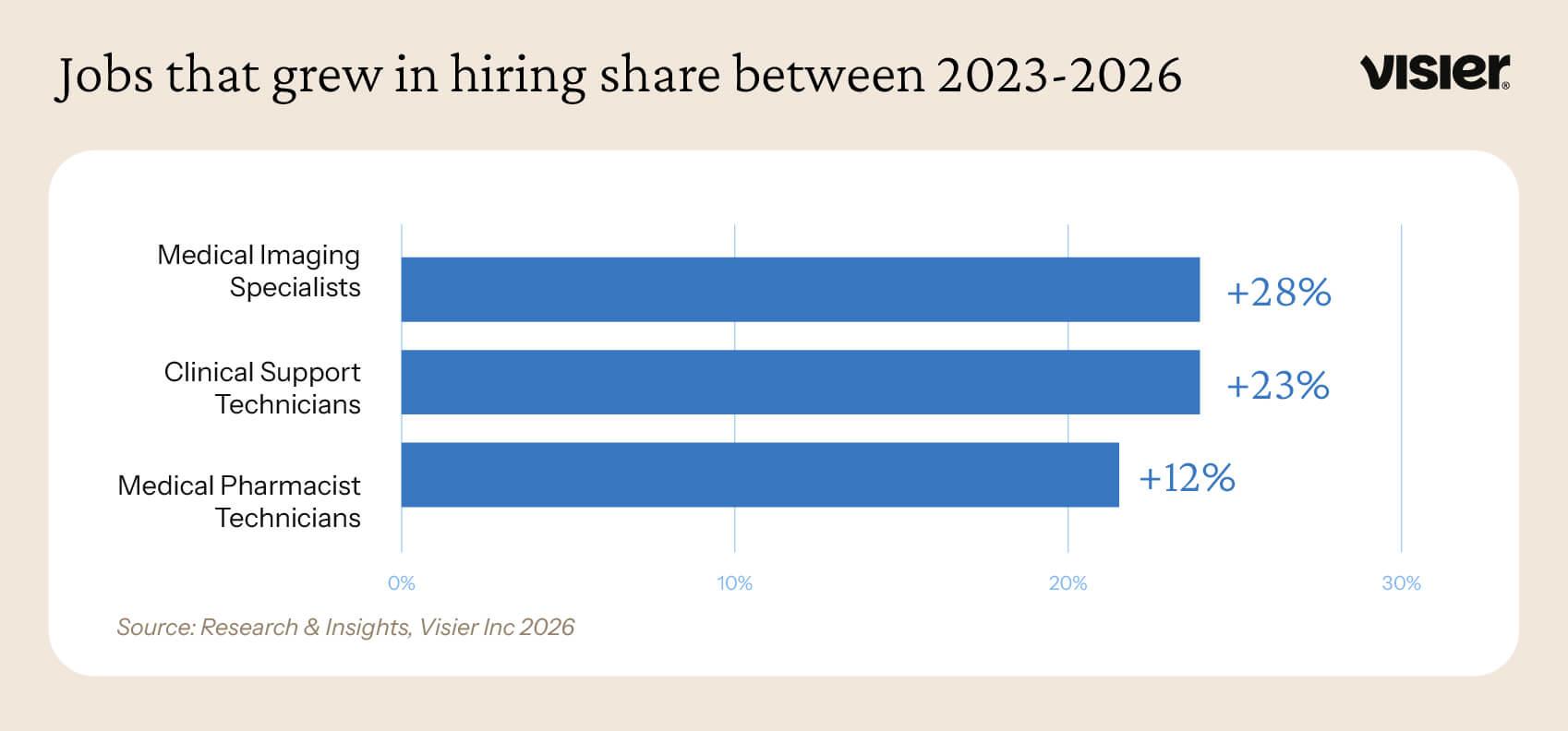
Healthcare roles with some of the most automatable skills are growing, not shrinking. From 2023 to 2026, hiring share rose 28% for Medical Imaging Specialists and 23% for Clinical Support Technicians.
The fastest hiring growth is in roles that depend on human judgment, led by Emergency Response Workers (+71%), Clinical Advisors (+69%), and Mental Health Specialists (+63%).
Healthcare leaders who plan around AI predictions instead of subdomain-level workforce data risk cutting the roles the market is hiring for.
A 2026 review in Diagnostics (opens in a new tab) looked at a decade of research on whether AI could replace clinicians. It found that AI performs best on “highly standardized, data-driven analytic tasks”: image triage, lesion detection, quantitative measurement, and documentation.
AI tools for imaging are already the most mature and widely deployed in clinical care. As a result, most discussion of AI in healthcare assumes imaging and other technician roles are the most exposed to automation.
Our data shows the reverse. Subdomains with some of the most automatable skills gained hiring share between 2023 and 2026:
Medical Imaging Specialists: +28%
Clinical Support Technicians: +23%
Medical Pharmacist Technicians: +12%
But some analytical roles do match the forecasts. Hiring share for Medical Laboratory Specialists, who analyze blood, tissue, and body fluids, has fallen 11% over the last four years. That’s closer to the AI-driven decline predicted for highly automatable roles.
The fastest hiring growth in healthcare is in roles that require specialized judgment and high-stakes human contact:
Emergency Response Workers: +71%
Clinical Advisors: +69%
Mental Health Specialists: +63%
Advanced Practice Providers: +31%
People in these roles work in unpredictable settings where they have to make decisions quickly and independently, often while patients are in crisis. AI can’t easily automate those skills, and healthcare organizations are hiring heavily for them.
As the Clinical Solutions Specialist we interviewed put it: “AI can tell somebody to do something, but until [it] can actually physically do it, it doesn’t stick as well.” In her career, she has seen AI speed up administrative work around her. But for core clinical work, she says, “[AI] isn’t my reality right now.”
An Emergency Response Worker, a Mental Health Specialist, and a Medical Laboratory Specialist face different demand pressures, different exposure to AI, and different talent needs. If you plan around broad workforce predictions, or worse, assumptions about which roles AI will affect, you lose sight of your actual workforce.
Can your organization afford to plan around predictions instead of data? If you cut technician pipelines because you expect AI to take over that work, you could end up short on the roles the market is hiring for. If you underinvest in crisis and specialist care, you could fall behind on the roles patients depend on most.
These two findings are only part of the story. The Workforce Intelligence Brief: Healthcare Edition shows which roles on the care ladder are disappearing, and why that trend could put more than staffing at risk.
Get the subdomain-level data, the full story of healthcare’s “disappearing middle,” and a CHRO checklist to help you plan the workforce your organization needs next.